Finding a reliable deep-cycle battery for marine, RV, and off-grid use is essential for steady power on the water and away from shore power. This guide highlights five top options, spanning AGM and LiFePO4 chemistries, to help you compare durability, weight, and cycle life. Each pick is ideal for trolling motors, cabin systems, and essential electronics, with details drawn from user-friendly specs and performance features.
| Product | Key Benefit | |
|---|---|---|
| Weize Deep Cycle AGM 12V 100Ah | AGM Lead-Acid | Low self-discharge; maintenance-free |
| CHITOLI 12V 100Ah LiFePO4 Group 24 | LiFePO4 | Long cycle life; lightweight |
| Newport 12V50Ah Deep Cycle AGM | AGM Lead-Acid | Lightweight marine option; trolling motor ready |
| Interstate Batteries Marine Deep Cycle 12V 100Ah | Pure Lead AGM | High deep-cycle power; rugged construction |
| Renogy Deep Cycle AGM 12V 100Ah | AGM Lead-Acid | Strong safety profile; versatile connections |
These selections cover a range of priorities, from weight savings and long life to robust performance in cold or high-demand marine environments. Each product is built to handle trolling motors, cabin electronics, lighting, refrigeration, and off-grid charging setups, offering a mix of traditional AGM reliability and the modern advantages of LiFePO4 chemistry.
Weize Deep Cycle AGM 100Ah Battery
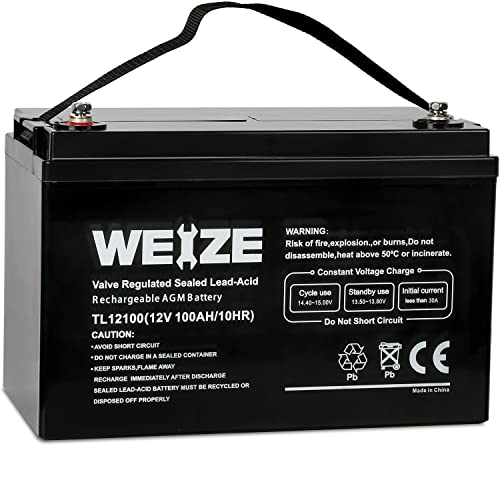
The Weize 12V 100Ah AGM battery is designed for maintenance-free operation with a sealed lead-acid design. It features a typical 1,100A max discharge current for brief high-load events and a low self-discharge rate that supports longer storage when not in use. Working temperatures span from -10°C to 50°C, with an optimal range around 25°C, making it suitable for varying marine climates. Its AGM construction reduces the risk of acid leaks, which is important in portable and space-constrained installations like boats and RV compartments.
Key considerations include storage conditions, ensuring a charged state to maximize lifespan, and the compatibility of AGM terminals with your boat’s power bus. This option suits users seeking a dependable, maintenance-free battery for trolling motors, solar setups, or off-grid cabin systems where weight and reliability matter.
CHITOLI 12V 100Ah LiFePO4 Battery

The CHITOLI LiFePO4 battery offers a lightweight alternative to lead-acid, with a much higher energy density. It weighs roughly 22.6 pounds for a 100Ah package, enabling easier handling on boats and in RV compartments. The built-in BMS provides protection against over-charge, over-discharge, and short circuits, supporting safe operation across a range of temperatures. The battery claims thousands of cycles with full depth-of-discharge (DOD) at lower degradations, which translates into long-term value for users who frequently cycle their power needs.
Considerations include ensuring the system is designed for lithium chemistry (proper charging voltages, BMS compatibility, and potential need for a dedicated lithium charger). While lead-acid systems remain common, LiFePO4 can dramatically extend run time per charge and reduce weight for marine applications requiring portability or frequent recharging.
Newport 12V 50Ah Deep Cycle AGM

This Newport Vessels model is a lightweight, sealed AGM battery designed for marine use, emphasizing ease of transport and installation aboard smaller vessels. Weighing around 32 pounds, it balances weight and performance for trolling motor setups and cabin power. The sealed construction minimizes leakage risk, contributing to reliability in damp marine environments. Designed for trolling motors, it also serves as a compact power source for alarms, lighting, and other auxiliary equipment on fish boats and small cruisers.
Important considerations include the battery’s available capacity for your amperage draw and the compatibility of the boat’s charging system with AGM chemistry. Its lighter weight can be a benefit for frequent repositioning or top-off charging during extended days on the water.
Interstate Batteries Marine Deep Cycle 12V 100Ah

The Interstate 100Ah AGM battery is built as a two-in-one unit, capable of cranking the engine while delivering deep-cycle power to trolling motors and onboard electronics. The design emphasizes rugged construction and extended service life, aiming to deliver 2x-3x longer life than conventional flooded batteries and improved recharge efficiency. This model targets boaters who require dependable, continuous power for navigation, lighting, and accessories even under heavy use.
Considerations include ensuring your system can handle a pure lead AGM profile, verifying fit within your boat’s battery compartment, and matching charging profiles to preserve longevity. The brand’s emphasis on durability makes it a strong candidate for larger vessels that demand consistent, reliable power across seasons.
Renogy Deep Cycle AGM 12V 100Ah

Renogy’s 12V 100Ah AGM battery is a widely trusted option in marine and off-grid setups. It supports series and parallel configurations, enabling scalable battery banks for larger demands, and its safety profile reduces maintenance concerns. The integrated design helps minimize off-gassing and leaks, which is valuable in enclosed compartments on boats or RV bays. In addition to residential-style use, Renogy batteries are popular for RVs and cabins requiring dependable, maintenance-free power with straightforward charging and discharging behavior.
Key considerations include compatibility with your charging source, the desired battery bank topology, and the need for monitoring to optimize cycles. The capacity and safety features make Renogy a go-to choice for users seeking dependable performance with broad compatibility across solar and engine-off power scenarios.
Buying Guide: Key Purchase Considerations And Comparisons
- Chemistry: AGM batteries are robust, maintenance-free, and well-suited for mixed loads, while LiFePO4 options offer longer cycle life and significant weight savings, at a higher upfront cost. Choose based on how often you deep-cycle and how important weight and longevity are to your setup.
- Cycle Life and Depth Of Discharge: LiFePO4 typically delivers thousands of cycles at 60-80% DOD, whereas AGM lead-acid often delivers hundreds to about a thousand cycles. Assess how deeply you regularly discharge and plan for future replacements accordingly.
- Weight And Space: LiFePO4 packs are notably lighter, which matters for smaller boats or RV compartments where weight distribution is critical. AGM batteries are heavier but often more affordable and easier to install in existing systems.
- Charging Compatibility: Verify charger settings compatibility with the chosen chemistry. Lithium systems may require a dedicated BMS and precise charging voltages, while AGM systems often work with conventional lead-acid charging profiles.
- Temperature Tolerance: Marine environments can swing temperatures. Look for batteries with wide operating ranges and good cold-cranking capabilities if you use electronics or starting systems in winter conditions.
- Physical Fit: Check terminal types, dimensions, and fit within your battery tray or compartment. Some models offer compact dimensions and lighter builds that fit into tight spaces.
- Maintenance: AGM batteries are maintenance-free, making them appealing for remote boats or RVs. LiFePO4 cells also require minimal maintenance but may need a compatible charging setup and monitoring system for optimal performance.
- Cost Of Ownership: Although LiFePO4 has a higher upfront price, its longer lifespan can reduce total cost of ownership over time. AGM models often present lower upfront costs but may need earlier replacements depending on use.
- Warranty And Support: Look for batteries with solid warranties and readily available support, especially for marine environments where reliability matters for safety and core systems.
- Use Case Balance: For high-power starting needs alongside trolling motors, dual-purpose AGM batteries can be a practical compromise. For long remote runs with solar or cabin systems, LiFePO4 can maximize runtime and weight savings.
Ultimately, the best choice depends on your boating or camping profile: power needs, anticipated discharge patterns, weight limits, climate, and the charging ecosystem you already have. The five options above illustrate the spectrum—from traditional maintenance-free AGM to advanced LiFePO4—helping you select a battery that aligns with performance expectations and operational requirements.