Camping off the grid requires reliable, portable solar power that can keep your camper energized without frequent recharging trips. This article highlights five strong solar panel kits and accessories tailored for van life, emphasizing efficiency, durability, ease of use, and compatibility with common RV and camper electrical setups. Each option below is backed by reputable brands and real-world performance data to help you compare at a glance.
| Product | Brand | Max Power | Type | Key Benefit |
|---|---|---|---|---|
| ECO-WORTHY 200W Kit | ECO-WORTHY | 200W | Rigid Panel Kit | High efficiency cells with durable frame |
| Renogy Adventurer 200W Kit | Renogy | 200W | Rigid Panel Kit | Compact footprint with reliable PWM controller |
| GRECELL UB200 200W Portable | GRECELL | 200W | Foldable | Ultra-portable with high efficiency |
| GRECELL 350W Portable Panel | GRECELL | 350W | Foldable | High power in a foldable package |
| SUNER POWER 30W Waterproof | SUNER POWER | 30W | Foldable/Compact | MPPT-enabled, compact charging |
ECO-WORTHY 200W Solar Panel Kit for RVs

ECO-WORTHY offers a robust 200W kit designed for RVs, caravans, and other off-grid vehicles. The kit uses high-efficiency monocrystalline cells, delivering strong power output under favorable sun. The aluminum frame is corrosion-resistant, built to endure wind and snow loads, with an IP65-rated junction box for weather protection. The system is suitable for daily outputs around 800Wh under good sun, making it a solid choice for campers aiming to support essential loads during extended trips.
Renogy 200W Adventurer Kit For RVs
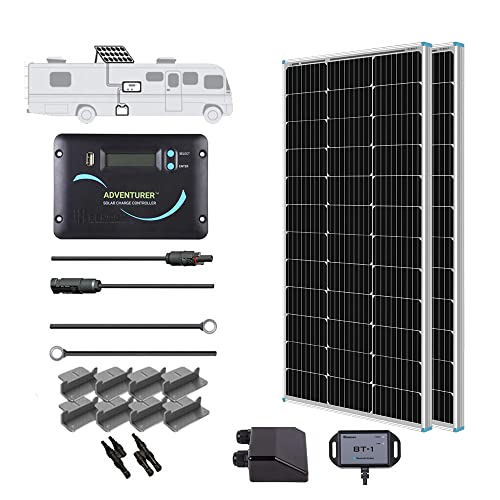
Renogy’s 200W Adventurer kit pairs a high-efficiency 22% solar cell panel with a sturdy aluminum frame designed to withstand outdoor conditions. The Adventurer-Li PWM controller supports safe charging and multiple protections, including overcharge and short-circuit safeguards. This kit suits campers who want a reliable, compact solution that fits a variety of vehicle sizes while maintaining long-term durability in wind and snow conditions.
GRECELL UB200 200W Portable Kit

GRECELL’s 200W portable foldable panel emphasizes portability for van life. It features a high conversion efficiency, up to 23.5%, and a lightweight design around 10 pounds. The package includes multiple connectors to accommodate various power stations, and its ETFE surface enhances durability and weather resistance. The built-in smart chip adjusts charging to maximize speed while protecting devices from overcharging, making it a practical add-on for compact camper setups.
SUNER POWER 30W Waterproof Solar Panel Kit

SUNER POWER’s compact 30W kit targets minimal-load van applications with Ultra-Smart MPPT technology that boosts efficiency up to 99% tracking. The improved three-stage charging (bulk, absorption, float) helps maintain battery health and extend life, while the IP67-style enclosure reduces moisture risk in challenging environments. This kit is ideal for campers needing a small, reliable trickle charger to top off a battery during shorter trips or as a supplementary source of power for lights and devices.
Buying Guide: Key Purchase Considerations
When choosing solar power for a camper van, consider power needs, space, and climate. Start by calculating daily energy consumption in watt-hours and select a panel or kit that can meet or exceed that demand under typical sun exposure in your travel regions. For larger vans or full-time living, 200W–350W rigid or foldable kits paired with a capable charge controller offer a good balance of output and portability.
Efficiency matters, especially in lower-light conditions. Monocrystalline cells perform better in partial shade or cooler climates, while ETFE-coated surfaces increase durability and longevity. Durability features such as corrosion-resistant frames, weatherproof junction boxes, and reinforced mounting points reduce maintenance and replacement costs over time.
Portability versus permanence is a trade-off. Foldable panels are excellent for travelers who want to store gear compactly when on the road, whereas rigid panels offer longer-term reliability and simpler mounting on a fixed van roof. Controllers should provide protections like overcharge, reverse polarity, and short-circuit safeguards. PWM controllers are common and reliable for mid-range setups, while MPPT controllers optimize efficiency in variable sun, particularly with higher wattage systems.
Installation ease and compatibility with existing battery systems (AGM, LiFePO4, GEL, flooded lead-acid) influence decision-making. Look for compatibility notes in product descriptions, included cabling, and connector options. Some kits include mounting brackets or kickstands, which simplifies positioning and reduces installation effort on a van roof or ground setup.
Budget and future expansion are practical considerations. A modular approach—starting with a core 200W–300W system and adding panels or a larger controller later—lets you scale without major rework. Finally, consider warranty coverage and brand support, as camper van environments demand reliable performance and accessible assistance.