Choosing a reliable 5-channel car amplifier is essential for delivering clean, powerful sound across your front and rear speakers while driving your subwoofer to its full potential. Below are five top options that balance efficiency, cooling, and tuning controls to help you achieve cohesive, high-impact car audio. The selections focus on compact Class D designs with protective features, remote sub controls, and flexible crossovers to suit a wide range of setups. Read on for detailed product sections, a concise buying guide, and practical comparison points.
| Product | Brand | Key Feature |
|---|---|---|
| STINGER MT-1000.5 | STINGER | 1,200W RMS, Class D, remote sub bass knob |
| BOSS PV3700 | BOSS Audio Systems | 5-channel, 37-1000W total power, high/low inputs |
| Rockville dB55 | Rockville | 4,000W peak, 2-ohm and 4-ohm ratings, adjustable crossover |
| RECOIL RED1800.5 | RECOIL | 1,800W max, 1Ω stability, bass remote included |
| AudioControl EpicFive | AudioControl | 1,100W RMS, EpicBoost, epicenter link, subsonic/high-pass filters |
STINGER MT-1000.5 5-Channel Car Amplifier
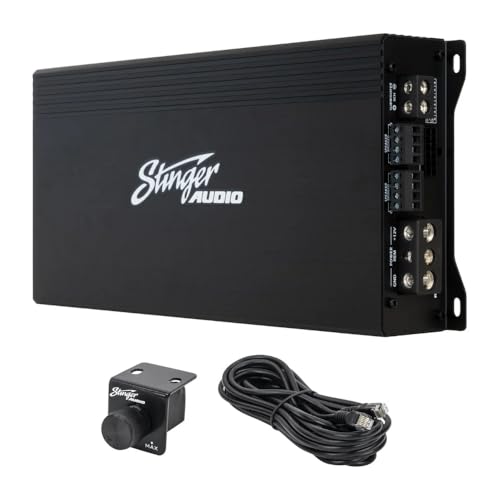
The STINGER MT-1000.5 is a digital Class-D five-channel amplifier designed for high efficiency and compact installations. With a robust 1,200W RMS total power and a dedicated subwoofer channel, it supports precise crossover control through high-pass and low-pass filters and includes a remote subwoofer bass knob for on-the-fly tuning. The device emphasizes rugged, compact build quality to handle long driving sessions without overheating, making it a practical choice for modern vehicles with space constraints.
BOSS PV3700 5-Channel Car Amplifier
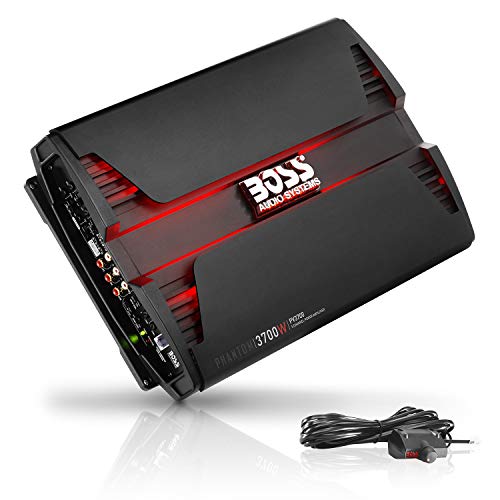
The BOSS PV3700 delivers a versatile 5-channel configuration with solid output across 2- and 4-ohm loads. With 550W x 4 (2-ohm) and 1,100W bridged at 4 ohms, it accommodates full-range speakers while still powering a subwoofer. It provides both high and low-level inputs, plus a selectable crossover to tailor high-frequency and low-frequency signals. The PV3700 is designed for straightforward installation and reliable daily use, appealing to enthusiasts who want a single, all-in-one solution.
Rockville dB55 4000W 5-Channel Amplifier

The Rockville dB55 is geared toward high-power installations, delivering up to 4,000W peak with 120W x 4 channels plus 500W for the sub at 2 ohms. It keeps a balance of performance and heat management through a high-speed MOSFET power supply and a fully adjustable 12dB/octave crossover. Subsonic filtering and a bass EQ further assist in tonal shaping, making it a strong choice for bass-forward systems that demand control and clarity in a single chassis.
RECOIL RED1800.5 5-Channel Amplifier

The RECOIL RED1800.5 delivers 1,800W max with a 1Ω stable mono channel, alongside four channels suitable for midrange speakers. It uses a high-speed MOSFET power supply and robust internal components, with protective circuitry to guard against common automotive stressors. A bass remote control is included for quick on-the-fly bass adjustments, helping drivers optimize sound while on the move. This model emphasizes efficiency and durability in demanding setups.
AudioControl EpicFive 1100W 5-Channel

The AudioControl EpicFive delivers 1,100W RMS in a compact Class-D package with Epic Boost to enhance loudness while preserving fidelity. It includes the Epicenter Link for seamless connection to bass processing hardware and a dedicated subsonic/high-pass filter set to optimize multi-zone listening experiences. The design emphasizes clean signal handling and protection features to maintain sound quality across varied road conditions.
Buying Guide: Key Purchase Considerations
- Power and channel distribution: Ensure the amplifier provides enough RMS power across each channel for your speakers and sub. Look for a model rated for your impedance (2Ω, 4Ω, or 1Ω) and confirm stable operation in bridge modes if you plan to combine channels for a subwoofer.
- Class and efficiency: Class D amplifiers are favored for car use due to high efficiency and reduced heat, which helps preserve battery life and prevent heat-related performance drops during long drives.
- Crossover and filtering: A flexible crossover network (high-pass, low-pass, and subsonic filters) helps tailor frequencies to each speaker, minimizing distortion and phase issues between channels and the subwoofer.
- Tuning controls: Bass boost, EQ, and remote bass knobs enable real-time adjustments for seat position, listening preferences, and music genre without reaching for the head unit.
- Protection features: Look for thermal protection, short-circuit protection, and high-quality build components to safeguard both the amplifier and your vehicle’s electrical system in varying climates.
- Installation footprint: Compact dimensions and exact mounting options matter for modern vehicles with tight installation spaces. A small but powerful unit can avoid bulkhead clearance problems.
- Remote bass control compatibility: If you want flexible bass adjustments from the driver’s seat, confirm the amplifier includes or supports a remote bass knob or compatible external control.
- System synergy: Choose an amplifier that pairs well with your head unit, subs, and speakers. Some models offer integrated features like epicenter compatibility or dedicated sub channels for smoother integration.
- Budget and reliability: While higher-end models offer more feature sets, there are reliable, cost-effective choices that deliver solid performance for daily driving and weekend setups. Consider warranty and support options as part of total value.
In practice, the best choice depends on your car audio goals: whether you prioritize maximum bass impact, a compact install, or precise tuning across multiple channels. The five options highlighted above cover a spectrum of configurations, from compact, energy-efficient designs to high-power, feature-rich units. When evaluating, map your vehicle’s speaker layout, your subwoofer requirements, and your preferred tuning workflow to pick the amplifier that best fits the cabin acoustics and your listening environment.