Car stereo amplifiers boost your audio system by delivering clean power to your speakers, increasing clarity, bass, and overall volume without clipping. This guide highlights five high-quality options spanning budget-friendly to performance-focused, helping you choose the right amp for your vehicle. Each entry includes key specs, a linked product page, and a quick look at what sets it apart. Use this overview to compare power delivery, input options, and tuning controls before you buy.
| Product | Brand | Estimated Power Notes | Key Feature |
|---|---|---|---|
| Skar Audio RP-1200.1D | Skar Audio | 1,200W RMS @ 1Ω | Mono, remote bass EQ |
| BOSS R1100M | BOSS Audio Systems | 1,100W @ 2Ω | Low/High level inputs |
| Pioneer GM-A3702 | PIONEER | 60W x 2 RMS @ 2Ω; 500W max | Bridgeable, signal sensing |
| Crunch PDX-1000.4 | Crunch | 1,000W max into 4 ch | 4-channel SEPP design |
| Orion Cobalt CBA2500.4 | ORION | 2/4Ω stable; up to 2,500W | Low/High pass, MOSFET |
Skar Audio RP-1200.1D Monoblock Amp
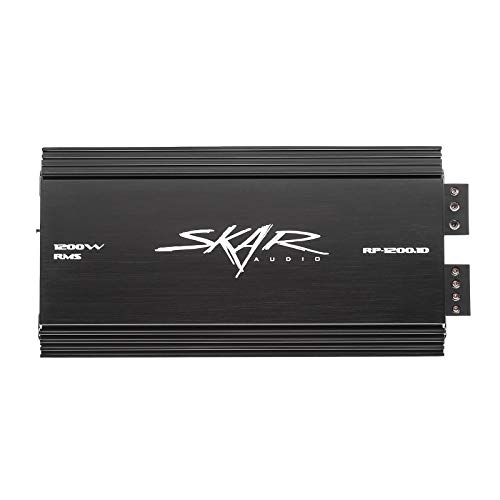
The Skar Audio RP-1200.1D is a Class D monoblock amplifier designed for demanding subwoofer duties. It delivers 1,600W peak power and 1,200W RMS at 1 ohm, featuring a 20Hz–250Hz frequency response and an onboard bass EQ switch for +6 or +12 dB boost at 45Hz. The MOSFET power stage supports efficient, high-current delivery, making it suitable for sealed or ported sub setups that require tight, deep bass and minimal heat buildup.
BOSS R1100M Monoblock Amp

The BOSS Audio Systems R1100M is a compact monoblock amplifier built for high output with 1,100W max at 2 ohms. Its design includes MOSFET power supply, a low-pass filter, bass boost, and adjustable input sensitivity. It supports both low and high-level inputs, plus a remote subwoofer control for on-the-fly tuning, making it a practical choice for upgrading an existing factory head unit or a modest aftermarket setup.
Pioneer GM-A3702 2-Channel Amp

The Pioneer GM-A3702 is a 2-channel Class AB amplifier designed to bridge for more power. It delivers up to 60W RMS x 2 at 2 ohms (190W RMS in bridged mode) with a robust 500W max output. Its efficiency-focused Class AB design balances performance with thermal management, making it suitable for upgrading front-stage speakers while maintaining reasonable heat generation for daily driving.
Crunch PDX-1000.4 4-Channel Amp
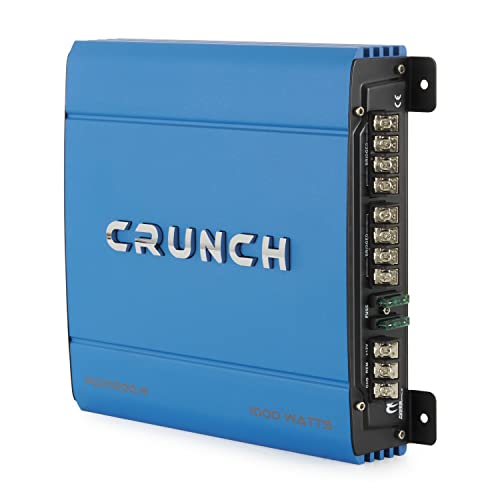
The Crunch PDX-1000.4 is a 4-channel amplifier rated for up to 1,000W max, delivering 125W x 4 at 4 ohms or 250W x 4 at 2 ohms. It features a SEPP analog design with fully adjustable 24dB crossovers for precise tuning and low distortion. It supports flexible installation through RCA input/output options, useful for multi-amp or multi-speaker configurations in larger systems.
Orion Cobalt CBA2500.4 4-Channel Amp

The Orion Cobalt CBA2500.4 is a high-efficiency Class A/B amplifier offering 2/4 Ohm stability and up to 2,500W continuous power. It uses a MOSFET power supply and provides a low- and high-level input, as well as adjustable low/high-pass filters and bass boost. This model targets users seeking substantial headroom for front and rear channels while keeping distortion in check during demanding dynamic passages.
Buying Guide: Key Purchase Considerations
Power needs and load compatibility:
- Match the amp’s RMS power to your speakers or subwoofers to avoid underpowered or overpowering behavior.
- Consider impedance, ensuring the amp is stable at the speaker’s rated ohms (2Ω, 4Ω, or 1Ω for some subs).
Channel configuration and flexibility:
- Mono amps are ideal for subwoofers; multi-channel models suit component systems with separate front and rear channels.
- Bridging capability in 2-channel amps expands power to subwoofers or larger speaker arrays.
Signal inputs and ease of tuning:
- Low-level (RCA) inputs are standard for most head units; high-level inputs help integrate with factory radios.
- Adjustable crossovers (low-pass and high-pass) and bass boost let you tailor frequency response to your speakers and listening preferences.
Thermal management and protection:
- Look for ample heatsinking and protection circuits (thermal, overload, short protection) to preserve performance in hot climates or long listening sessions.
- Class D designs save space and reduce heat, while Class AB offers different sonic characteristics and efficiency trade-offs.
Size, installation, and compatibility:
- Measure mounting space and verify the mounting feet and overall dimensions fit your vehicle’s trunk or cabin layout.
- Check electrical requirements and wire gauge recommendations to ensure safe, consistent performance.
Budget vs. performance balance:
- Higher-wattage models offer more headroom, but the listening environment, speaker quality, and head-unit output shape the audible benefit.
- Some models include onboard EQ, remote controls, or crossovers that simplify setup and tuning but may add cost.