Carbon buildup on intake valves can impact throttle response, power, and fuel economy. The following selections are aimed at removing stubborn carbon deposits from intake valves, combustion chambers, and related pathways, helping restore engine efficiency. Each product targets modern engines, including GDI and turbocharged systems, with varying application methods to suit different maintenance routines.
| Product | Brand | Key Benefit |
|---|---|---|
| Gumout Foaming Intake Valve & Turbo Cleaner | Gumout | Deep cleaning with foaming action; improves throttle response and idle |
| CRC GDI IVD Intake Valve & Turbo Cleaner | CRC | High-concentration detergency for GDI and turbo systems |
| Berryman 2611 Intake Valve & Combustion Chamber Cleaner | Berryman | Polyetheramine formula dissolves carbon in combustion chambers |
| Engine Intake Valve Cleaner Spray – GDI Safe | Generic | GDI-safe spray to clean valves and chambers; lubricates upper engine parts |
| DURA LUBE Valve Cleaner | DURA LUBE | Carbon and gum buildup dissolution; supports fuel system cleanliness |
Below are five products selected for relevance to intake valve carbon cleaning, each offering different application methods and engine compatibility. This guide can help you compare approaches—from foaming cleaners that cling to surfaces to spray-and-lubricate options for upper engine cleaning and valve deposition removal.
Gumout Foaming Intake Valve & Turbo Cleaner

Gumout’s foaming formula adheres to intake surfaces within the manifold, intake valves, and combustion chamber for deep cleaning. The product’s foaming action helps dissolve and lift carbon deposits that accumulate in modern engines, including turbocharged and GDI configurations. By removing buildup from critical areas, the cleaner can contribute to restored horsepower, improved throttle response, and smoother idle. Use as part of routine maintenance to keep intake pathways clear and engine efficiency high.
CRC GDI IVD Intake Valve & Turbo Cleaner

CRC’s formula is designed for GDI engines and turbocharged systems, where carbon buildup can be most pronounced. The cleaner is installed through the air intake system and uses a high-detergency component to address valve deposits and related carbon since the intake path is a primary accumulation point in modern engines. This product is noted for its effectiveness on high-precision systems that require careful cleaning without premature wear on sensitive components.
Berryman 2611 Intake Valve & Combustion Chamber Cleaner
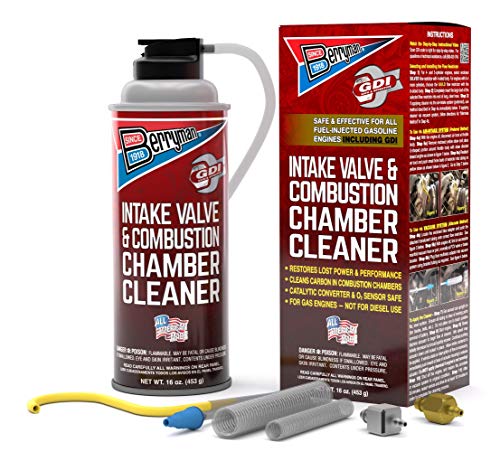
Berryman’s 2611 cleaner is formulated to work across all fuel-injected gasoline engines, including GDI. It contains Polyetheramine (PEA) to dissolve carbon deposits in combustion chambers and on all valve types. The product is designed to clean both intake valves and combustion surfaces, helping restore efficiency and reduce deposits that can hinder performance. It’s suitable for engines with varied fuel delivery systems and is commonly used for thorough carbon removal in multiple engine zones.
Engine Intake Valve Cleaner Spray – GDI Safe

This spray is marketed as a GDI-safe cleaner that targets the upper engine areas, including intake valves and combustion chambers, through the intake system. It is designed for modern GDI engines where fuel additives may not reach all surfaces, making direct cleaner delivery advantageous. The product also advertises lubrication benefits for throttle plates and upper engine components, providing a dual-action approach to carbon removal and component protection during and after cleaning.
DURA LUBE Valve Cleaner

DURA LUBE’s valve cleaner emphasizes dissolving carbon and gum buildup on intake valves and combustion chambers while supporting overall fuel system cleanliness. The formulation targets both cleaning and improving fuel atomization, potentially contributing to smoother operation and better throttle response. Regular use may help sustain engine cleanliness, especially in engines experiencing carbon-related performance issues over time.
Buying Guide: Key Considerations For Choosing An Intake Valve Cleaner
- Engine type compatibility: Modern engines with GDI or turbocharging may require cleaners formulated specifically for GDI, direct injection, or turbo systems to avoid interaction with sensitive components.
- Delivery method: Foaming cleaners cling to surfaces for deep cleaning, while sprays provide targeted cleaning with potential lubrication benefits. Some products are designed to be introduced through the intake system, while others are added via the fuel system or direct cleaning spray.
- Detergency strength: Higher-detergency formulations may remove carbon more aggressively but should be used as directed to avoid solvent-related risks on seals or gaskets.
- Vehicle maintenance cycle: Consider how often you plan to clean and whether you want a one-time treatment or a routine maintenance product integrated into scheduled service intervals.
- Safety and compatibility: Check for claims about safe use with turbocharged, GDI, or high-pressure fuel systems. Some cleaners emphasize lubrication properties for upper engine components in addition to carbon removal.
- User experience: Look for products with straightforward application instructions, and consider whether you prefer an in-vent intake delivery method or a can that is sprayed through the throttle body and intake valves.
- Environmental and safety considerations: Choose formulations that balance cleaning effectiveness with environmental and operator safety, including proper ventilation during use.
In summary, the listed products provide a range of approaches for removing carbon buildup from intake valves and related areas. When evaluating options, consider your engine type, cleaning goals, and maintenance routine to select the most suitable cleaner for maintaining intake valve efficiency and overall engine performance.