In the modern mobile era, staying connected while driving matters—from hands-free calls to streaming maps and music. A car cell phone booster antenna system can significantly improve signal quality, reduce dropped calls, and speed up data on 4G LTE and 5G networks across major U.S. carriers. Below, you’ll find five top options with strong performance, FCC approval, and carrier compatibility. Each section highlights key features, ideal use cases, and practical considerations to help you choose the right booster for your vehicle type and driving needs.
Summary of chosen products
- Atcall C5 Cell Phone Booster for Car: Broad carrier support, up to 50 dB gain, omni-directional outdoor antenna.
- weBoost Drive Reach Overland: Rugged, off-road ready, made in the USA, broad 5G/4G support.
- HiBoost Car Signal Booster with Enhanced Roof Antenna: Precision RF components, heat-dissipating design, broad carrier compatibility.
- weBoost Drive Reach Antenna (Model 311248): External antenna for maximum range, compatible with all major U.S. carriers.
- Nstcell Home/Multi-Room Booster (Indoor use up to 7000 sq ft): Large coverage for home or office, supports 5G/4G LTE across carriers.
Best Overall Car Booster: Atcall C5

The Atcall C5 is designed to support all major U.S. carriers, including Verizon, AT&T, and T-Mobile. It delivers advanced 5G and 4G LTE performance with a maximum gain up to 50 dB, helping multiple devices in the vehicle stay connected with clearer calls and faster data. An omni-directional outdoor magnetic antenna simplifies setup since it does not require precise aiming. It is well-suited for cars, SUVs, and vans, and emphasizes reliable coverage in varying driving environments.
Key considerations:
– Carrier compatibility across the U.S. network list ensures broad usefulness for households with multiple carriers.
– The omni-directional antenna reduces installation time and is friendlier to drivers who want a quick setup.
– A 50 dB gain is strong for road use, though real-world results depend on exterior signal availability and interior layout.
WeBoost Drive Reach Overland

The Drive Reach Overland pairs a rugged outdoor antenna with a versatile mounting system, designed for off-road and adventure vehicles. It supports all U.S. carriers and keeps up with current 5G standards, aiming to provide fast speeds and dependable service even in remote areas. The kit’s emphasis on durability and a robust outdoor antenna makes it a strong choice for trucks, SUVs, campers, and other vehicles that frequently travel away from metropolitan coverage.
Key considerations:
– Outdoor antenna strength can extend reach to distant towers, boosting signal in challenging terrains.
– The kit targets all major networks, making it suitable for households with varied service providers.
– Built for adventures, it may require a more deliberate installation due to mounting requirements.
HiBoost Car Signal Booster with Precision RF
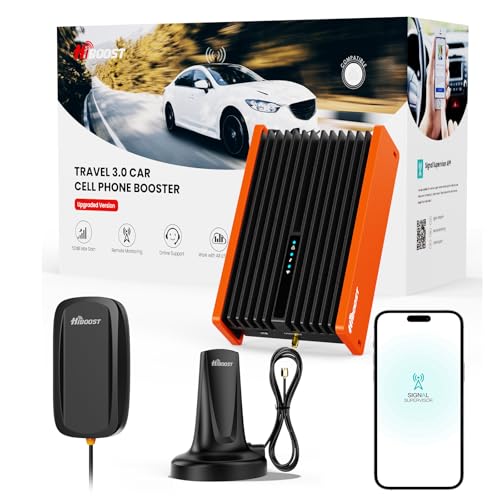
HiBoost emphasizes precision-grade RF components and a heat-dissipating honeycomb design to maintain performance and minimize heat buildup. It offers broad compatibility with all carriers, including Verizon, AT&T, and T-Mobile. The enhanced exterior design aims to provide faster signal transmission and better range, making it suitable for daily commuting, family road trips, and longer highway drives where reliable coverage matters most.
Key considerations:
– Precision 50-ohm RF connections can reduce signal loss compared with typical 75-ohm setups, potentially improving ongoing performance.
– Improved heat dissipation may help maintain performance during extended usage.
– Compatibility with all major U.S. carriers ensures broad applicability for mixed-device households.
JACOOL Car Booster for Truck, SUV, and RV

JACOOL’s booster targets heavy-traffic, larger vehicles and off-road usage with a robust design that supports bands 12, 13, and 17. It emphasizes that a minimum outdoor signal is required to trigger the boost, with status indicators and automatic gain control to optimize performance. The aluminum construction supports durability and improved heat management, making it a practical option for trucks and RVs where signals are often weak.
Key considerations:
– Band compatibility focused on common 4G/5G LTE bands helps ensure broad applicability in the U.S.
– AGC and an indicator light provide user-friendly status monitoring.
– Suitable for larger vehicles that traverse areas with inconsistent signal.
WeBoost Drive Reach OTR

Designed for extended-range performance, the Drive Reach OTR (Over the Road) targets trucks and SUVs with a focus on maximizing reach to distant towers. It remains compatible with all major U.S. carriers and supports contemporary 5G technology to deliver the best possible speeds on smartphones and connected devices during long drives. This model emphasizes far-reaching signal recovery and robust performance for mobile living and work needs on the road.
Key considerations:
– Long-range external antenna support can improve performance in areas with weak signal.
– USA-made manufacturing and FCC approval provide assurance of compliance and quality control.
– A good fit for fleet vehicles or individuals who frequently travel in regions with marginal coverage.
Buying Guide: Key Purchase Considerations and Comparisons
- Carrier compatibility: Ensure the booster supports the carriers you use (Verizon, AT&T, T-Mobile, U.S. Cellular, etc.). Most options in this list advertise broad support for all major U.S. networks.
- Outdoor vs indoor placement: Outdoor antennas provide longer-range gains, especially in remote areas. Indoor solutions are often simpler to install but may have reduced reach.
- Gain and coverage: Signal boost gain (measured in dBi or dB) matters, but real-world results depend on outside signal strength, interior layout, vehicle type, and the location of the exterior antenna. Higher gain can improve performance but may require more careful installation to avoid self-oscillation.
- Power consumption and installation: Some kits include mounting brackets, cables, and power adapters. Consider whether you need a portable, semi-permanent, or permanent installation.
- Build quality and durability: For off-road use, rugged designs and weatherproof components reduce maintenance and failure risk. Aluminum housings and heat-dissipation features are helpful for extended operation.
- Regulatory compliance: Look for FCC approval or other safety certifications to ensure the device meets regulatory standards and does not interfere with networks.
- Cost of ownership: Besides the initial price, factor in installation effort, potential vehicle rewiring needs, and future-proofing for evolving networks (5G). A higher-quality external antenna system can offer longer service life with better performance consistency.
- Use-case alignment: If you drive in urban areas with decent signal, a simpler omni-directional outdoor antenna may suffice. For remote trips or work vehicles, prioritize models with stronger outdoor reach and robust mounting options.
- Indoor coverage scenarios: For home or office use in addition to cars, some models in this list offer indoor multi-room capabilities. Assess whether you need a dual-use system or a dedicated vehicle solution.
All products listed provide FCC approval and are designed to improve call quality and data speeds by boosting weak signals to usable levels. When selecting a booster, consider your vehicle type, typical routes, and whether you prefer a quick-install option or a more rugged, all-terrain solution. For families with multiple devices, choosing a booster with a higher potential gain and a reliable outdoor antenna can deliver more consistent performance across passengers and devices.