Choosing the right check engine light code reader can save time and money by pinpointing issues fast. This guide reviews five reliable OBD2 scanners that work with most 1996 and newer vehicles, offering code reads, live data, readiness checks, and more. Learn how each device handles fault codes, data streams, and compatibility so you can pick a tool that fits your DIY needs or shop workflow.
| Product | Brand | Key Feature |
|---|---|---|
| ANCEL AD310 Classic Enhanced Universal OBD II Scanner | ANCEL | Fast reads and clears codes; live data; compact design |
| VDIAGTOOL VD10 OBD2 Scanner | VDIAGTOOL | Extensive DTC lookup; large TFT display; all OBDII protocols |
| MOTOPOWER MP69033 Car OBD2 Scanner | MOTOPOWER | Wide protocol support; real-time data; multilingual |
| FOXWELL NT301 OBD2 Scanner | FOXWELL | Live data, VIN retrieval, MIL reset |
| CGSULIT SC103 Car Code Reader | CGSULIT | Broad protocol support; 2.8″ display; easy to use |
ANCEL AD310 Classic Enhanced Universal OBD II Scanner

The ANCEL AD310 is a best-selling OBD II scanner widely used for diagnosing the cause of the check engine light. It reads and clears diagnostic trouble codes for emission systems, provides live data, and supports freeze frame and I/M readiness data. It is powered directly from the vehicle’s OBDII port, making it a battery-free option with straightforward operation. Its compact, sturdy design features a 2.5-foot cable and clearly labeled buttons, with a large screen for easy readability. Suitable for quick DIY checks or professional use, it delivers fast results to help identify the root issue and verify repairs.
VDIAGTOOL VD10 OBD2 Scanner
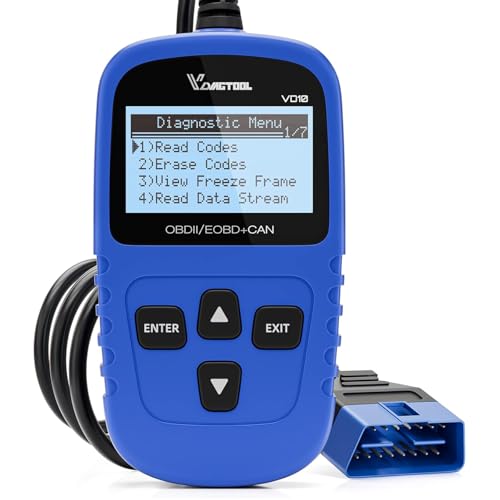
The VDIAGTOOL VD10 is designed for DIYers and hobbyists, offering a simple plug-and-scan approach. It retrieves generic and manufacturer-specific codes, clears codes, and shows DTC definitions from a built-in database with more than 3000 codes. The device provides freeze-frame data and I/M readiness status, and displays vehicle information to help diagnose issues quickly. Its straightforward interface makes it easy to understand what the car needs next, reducing guesswork and enabling faster maintenance decisions.
MOTOPOWER MP69033 Car OBD2 Scanner

The MOTOPOWER MP69033 offers broad protocol support, enabling its use with most 1996 US-based, 2000 EU-based, and Asian vehicles, as well as newer OBD II and CAN vehicles. It features a 2.8″ LCD display with backlight and contrast adjustment for easy viewing. The scanner reads and erases codes, shows live data streams, and provides I/M readiness, vehicle information, and data flow. It is battery-free, drawing power directly from the OBDII port, and presents a practical balance of features and portability for everyday diagnostics.
ANCEL AD410 Enhanced OBD2 Scanner

The ANCEL AD410 Enhanced OBD2 Scanner provides extensive emissions-focused diagnostics, including quick reading and clearing of fault codes, monitor readiness checks, and EVAP testing. It can test O2 sensors and EVAP systems to fine-tune the air-fuel mixture, contributing to better fuel efficiency. It powers directly from the vehicle and focuses on engine diagnostics, with a clear emphasis on clearing codes after issues are resolved. Note that it does not support ABS, SRS, or transmission systems, making it a targeted tool for engine diagnostics and related subsystems.
FOXWELL NT301 OBD2 Scanner

The FOXWELL NT301 targets professional-grade diagnostics with access to live data graphs, MIL control, VIN retrieval, and DTC reading. It emphasizes accurate code reading for a wide range of vehicles and provides data streams to help identify faulty sensors or components. While it does not support ABS or SRS for all models, the NT301 delivers clear fault code information and user-friendly operation for quick diagnostics and verification post-repair.
CGSULIT SC103 Car Code Reader

The CGSULIT SC103 is designed to cover a broad range of OBDII protocols and vehicles from 1996 onward. It features a vibrant 2.8-inch TFT color screen, a simple plug-and-play interface, and a compact, portable form factor. Users can read and clear diagnostic codes, view live data streams, and retrieve vehicle information. It emphasizes ease of use and accessibility for both beginners and professionals seeking a budget-friendly option with solid coverage.
Buying Guide
Key purchase considerations:
- Vehicle compatibility: Ensure the scanner supports your vehicle’s year, make, and model, and check for CAN or newer OBDII protocol support.
- Code reading and clearing: Look for devices that read generic and manufacturer-specific codes, provide clear definitions, and allow clearing the MIL once repairs are complete.
- Live data and freeze frame: Real-time sensor data helps diagnose problems beyond the initial fault code. A graphing view can reveal trends and intermittent issues.
- Special functions: Some tools offer I/M readiness, VIN retrieval, EVAP tests, or battery tests. Decide which features align with your needs.
- Display and usability: A readable screen, straightforward menus, and physical durability matter for hands-on use in garages or driveways.
- Power and portability: Tools that draw power from the OBDII port are convenient and portable, avoiding extra batteries or chargers.
- Future-proofing: If you anticipate newer vehicles or more complex diagnostics, opt for a scanner with broader protocol support and regular updates.
Perspective considerations:
- DIY user: Prioritize ease of use, clear code definitions, and essential live data. A compact unit with a long cable reduces clutter in small spaces.
- Professional mechanic: A wider protocol library, robust live data features, VIN retrieval, and advanced diagnostics can improve efficiency and accuracy in busy shops.
- Budget-conscious buyer: A scanner with broad compatibility and reliable core features offers good value without extra bells and whistles.
- Vehicle owner with frequent repairs: Tools that can quickly identify issues and confirm repairs via live data can shorten downtime and visits to shops.