Choosing the right electronic crossover is essential for a clean, balanced car audio system. The right unit can help your highs, mids, and lows blend seamlessly, maximize power handling, and minimize distortion. This guide highlights five prominent crossovers that show broad compatibility, adjustable filters, and robust modern features. Whether you’re upgrading a factory setup or building a multi-speaker system, these crossovers offer reliable performance and fine-tuning flexibility for American drivers seeking better in-vehicle sound clarity.
| Product | Brand | Key Feature |
|---|---|---|
| Taramps Crx4 Electronic 4 Way Crossover | Taramp’s | 4 channels, compact, customizable sound adjustments |
| PRV AUDIO Crossover EX3.5 | PRV AUDIO | 2/4 RCA inputs, 3-way/high/low pass filters |
| Pyle 2-Way Electronic Crossover | Pyle | 4 RCA outputs, LED indicator, remote sub control |
| Skar Audio SKEC23 3-Way 6 Channel | Skar Audio | 3-way, 6 channels, front/rear/sub separation |
| Recoil CRX-PRO 5-Way Electronic Crossover | RECOIL | 5-way bands, subsonic filter, studio-grade THD |
Below are five crossovers that cover a range of configurations and budgets, with features tailored to give you clean signal paths and flexible tuning for a better car listening experience.
Taramp’s Crx4 Electronic 4 Way Crossover

The Taramp’s Crx4 is a compact 4-channel electronic crossover designed for car audio systems requiring versatile channel routing. It supports customizable sound adjustments across multiple outputs, enabling precise tuning for each speaker pair. The unit is well-suited for owners who want a clean signal path with straightforward control over high-pass and low-pass filters, plus bass-related settings that help prevent speaker overextension.
PRV Audio EX3.5 Crossover
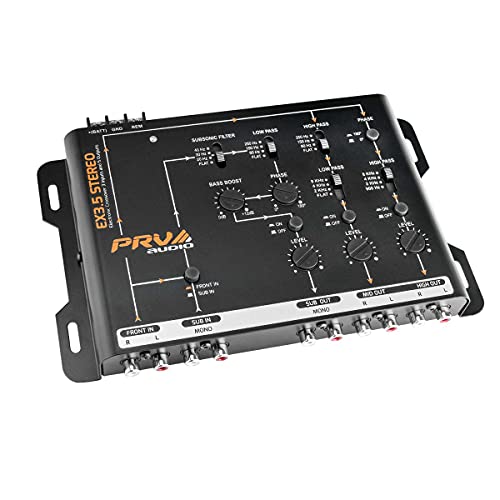
The PRV EX3.5 offers flexible 2/4 RCA inputs and up to 6 RCA outputs, enabling 2-channel and 3-channel configurations. It features 3-way adjustable high-pass and low-pass filters, output level control on each channel, and a bass boost option on the sub output. This makes it a strong choice for enthusiasts seeking granular control over a multi-amp or sub-woofer-inclusive setup.
Pyle 2-Way Electronic Car Audio Crossover

The Pyle 2-Way Electronic Crossover provides a straightforward 2-way configuration with high-pass and low-pass filtering. It includes four RCA outputs and two inputs, plus a remote subwoofer control and a parallel input switch. The design emphasizes a compact footprint with a clear LED indicator, making it easy to place in a tight dash area while maintaining accessible adjustments for everyday tuning.
Skar Audio SKEC23 3-Way 6 Channel

The Skar SKEC23 is a 3-way, 6-channel electronic crossover designed for multi-amp setups. It provides distinct inputs and outputs for front, rear, and sub channels, with a 14.4-volt operating voltage and up to a 5V maximum output. This model is well-suited for drivers who want precise channel separation to optimize staging and clarity across a larger system.
Recoil CRX-PRO 5-Way Electronic Crossover

The Recoil CRX-PRO offers a comprehensive 5-way frequency splitting with a subsonic filter, bass boost, and pass-thru output. It emphasizes studio-grade signal purity with ultra-low THD and strong crosstalk rejection, making it a compelling option for serious sound tuning and high-fidelity in-vehicle listening experiences. Its adjustable crossovers span a wide range from 30 Hz to 20 kHz for versatile tuning across different speaker configurations.
Buying Guide: Key Purchase Considerations
- Speaker count and channel configuration: Align the crossover’s channel count with your planned amplifier setup (2-channel, 4-channel, 6-channel, or 8-channel systems).
- Filter types and slope: Look for adjustable high-pass and low-pass filters with multiple slope options (e.g., 12 dB/24 dB per octave) to tailor transitions between drivers.
- Subwoofer integration: If you have a sub, choose a unit with a dedicated sub output and a bass boost or subsonic filter to protect subs and control low-end energy.
- Signal quality and THD: Lower total harmonic distortion and strong crosstalk rejection help preserve audio fidelity, especially in complex multi-amp setups.
- Ease of installation: Consider form factor, mounting options, and whether a remote sub control or easy LED indicators will simplify daily use.
- Compatibility: Ensure the crossover’s input/output configurations match your head unit and amplifiers (RCA, mono/stereo channels, etc.).
- Budget and future-proofing: Higher-end models often provide more precise control and better components, but even mid-range units can deliver substantial improvements for upgrader projects.
In summary, selecting the right crossover depends on how you plan to route audio to each speaker set, the number of channels you intend to drive, and how much control you want over tonal balancing. The five models featured here offer a blend of compact form factors, flexible routing, and robust tuning options to support a wide range of car audio ambitions across American driving environments.