Choosing the right car audio equalizer can dramatically improve sound quality by precisely shaping frequency response, reducing feedback, and aligning tones with your vehicle’s acoustics. The following five graphic and parametric equalizers are among the top options for American drivers seeking clear mids, punchy bass, and balanced highs. Each product includes multiple inputs, high-voltage outputs, and dedicated controls to tailor your listening experience on the road.
| Product | Brand | Key Feature | Inputs / Outputs |
|---|---|---|---|
| Clarion EQS755 | Clarion | 7-band graphic with 3.5mm aux and high-level inputs | Front/Rear/ Sub RCA outputs; 3.5mm Front Aux; High-level inputs |
| Taramp’s TEQ 7.4 Pro | Taramp’s | 7-band graphic equalizer with high sensitivity output | 2 input channels; 3 output channels; 12 V operation |
| Skar Audio SKA7EQ | Skar Audio | 7-band, 1/2 DIN with high voltage RCA outputs | Front/Rear/Sub outputs; Aux input with gain |
| PRV Audio DSP 2.4X | PRV Audio | Digital processor with 15-band EQ and presets | 2 inputs; 4 outputs; DSP with presets |
| DS18 EQX7PRO | DS18 | 7-band stereo EQ / crossover with multi-outputs | 3 RCA outputs; master and sub controls |
When evaluating these models, consider how many channels you need, whether you prioritize hardware simplicity or digital processing, and how much control you want over bass management and high-frequency clarity. The products below illustrate a range from entry-level graphic equalizers to advanced DSP-enabled units designed for custom tuning in modern cars.
Clarion EQS755: Classic Graphic Equalizer With Multi-Input Flexibility
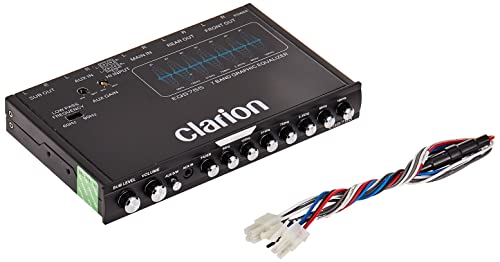
The Clarion EQS755 offers a traditional 7-band graphic equalizer setup with a built-in low-pass filter and multiple input options. It uses an 8-volt RCA output system for front, rear, and subwoofer channels, enabling strong, clean signal delivery. Independent master volume and subwoofer level controls with a fader create a flexible listening environment, useful for adjusting sound without re-running settings across multiple listening modes. Its front 3.5mm auxiliary input provides quick connect options for mobile devices or portable players, making it a practical choice for older setups or simpler aftermarket installs.
Key considerations include the independent master and subwoofer controls, which help dial in bass and overall level matching. The selectable 12 dB low-pass filter at 60 Hz or 90 Hz offers targeted sub emphasis, while blue illumination improves visibility in low-light vehicle interiors. This model excels in straightforward tuning scenarios and is compatible with a variety of head units that provide RCA outputs.
Taramp’s TEQ 7.4 Pro: High-Resolution Graphic Tuning

The Taramp’s TEQ 7.4 Pro delivers a robust 7-band graphic EQ with precise frequency placement (50 Hz to 12 kHz) and a high dynamic range suitable for complex car audio systems. It supports two input channels and three output channels, enabling versatile routing to front, rear, and subwoofers. The unit emphasizes low noise and high signal integrity, with a wide output voltage range and a low distortion profile. Its overall design supports aggressive tuning and is aimed at enthusiasts who want fine-grained control over tonal shaping for different music genres.
Pros include excellent headroom, a broad frequency spectrum, and strong performance for bass-heavy setups. The device is compact for 1/2-DIN installations, though wiring and installation may be more technical due to its signal routing options. This option suits those who want a dedicated, high-fidelity graphic equalizer without integrating full DSP processing.
Skar Audio SKA7EQ: 7-Band Pre-Amp With High Voltage Outputs
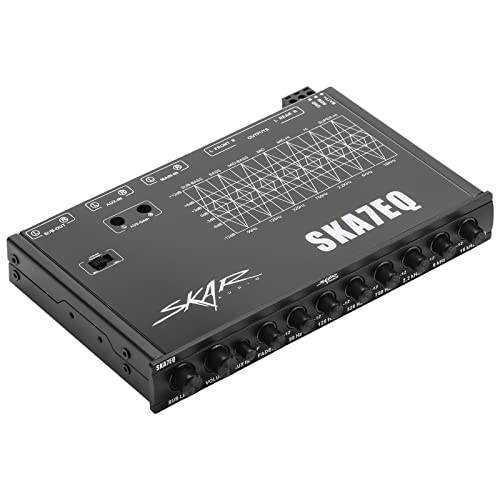
The Skar Audio SKA7EQ is a 7-band graphic equalizer designed for 1/2 DIN installation with high-performance outputs. It features two inputs (main and auxiliary with variable gain) and high-voltage RCA outputs to drive front, rear, and subwoofers. The device delivers low distortion and a strong signal, allowing clear vocal presence and balanced music across genres. Users can adjust tone with precision, especially in midrange and high frequencies, to compensate for common car cabin anomalies such as dashboard reflections and seat resonance.
Ideal for sound enthusiasts who want a straightforward, reliable graphic EQ with positive headroom and simple front-end control. This model pairs well with aftermarket amplifiers and is typically easier to install than full DSP units, making it a solid step up from basic passive equalization.
PRV Audio DSP 2.4X: Digital Processing With Graphic Equalization

The PRV Audio DSP 2.4X represents a step into digital domain tuning with a 15-band graphic EQ, multiple crossovers, and a user-friendly LCD interface. Real-time adjustments are available, and the processor supports two audio inputs with independent four-output channels. The device includes presets such as Flat, Loudness, Bass Boost, and more, enabling quick optimization for various music styles. This unit is well-suited for users seeking precise tonal control, improved loudness handling, and the ability to tailor each output path to specific amplifiers or speaker placements.
Considerations include the learning curve associated with DSP configuration and the need for a head unit or source capable of fully leveraging DSP features. The PRV 2.4X is ideal for installers aiming to build a customized, room-like car audio environment with adjustable crossovers and EQ across multiple zones.
DS18 EQX7PRO: Subtle Tuning With Integrated Outputs

The DS18 EQX7PRO combines graphic equalization with a robust crossover system, designed to optimize a multi-amplifier car setup. It features seven adjustable bands with clear LED indicators, allowing you to monitor signal levels at a glance. The unit supports three stereo outputs and independent controls for master volume and sub level, enabling precise balance across front, rear, and sub channels. Its high-visibility indicators help installers verify activity in dark environments, and the selectable input options accommodate common aftermarket head units.
DS18 emphasizes distortion control and signal integrity across the frequency range, making it suitable for users who want strong performance without moving into full DSP territory. The EQX7PRO’s flexible architecture supports a variety of speaker configurations and subwoofer alignments, helping to optimize imaging and soundstage in compact car interiors.
Buying Guide: Key Purchase Considerations
When choosing an equalizer for car audio, several factors determine long-term satisfaction. First, identify your system complexity. Simple systems benefit from graphic EQs with clear dials and straightforward inputs, while more elaborate builds may require DSP-enabled processors to manage multiple zones and crossovers precisely.
Second, consider input and output options. Look for units with at least two inputs and separate outputs for front, rear, and subwoofers if you plan multi-amp configurations. Aux inputs are useful for quick testing and mobile device connections, but many enthusiasts prioritize high-voltage RCA outputs for cleaner signal transfer to amplifiers.
Third, evaluate tuning flexibility. Graphic equalizers offer intuitive, quick adjustments across bands, whereas parametric or DSP-based units provide deeper control over bandwidth, Q, and dynamic range. If you want room to grow your system over time, a DSP option can pay off with more precise optimization for different music styles and vehicle acoustics.
Fourth, installation considerations matter. Some models are 1/2-DIN compatible and easier to retrofit in factory dashboards, while others may require more extensive wiring or professional installation. Consider your comfort level with wiring and calibration, especially for high-current outputs that demand proper grounding and power supply routing.
Finally, assess build quality and resistance to vehicle conditions. Look for solid chassis, robust connectors, and clear labeling to minimize install errors. For nighttime visibility and ease of use, models with backlit controls or LED indicators can be a practical advantage when driving after dark.