When upgrading a flatbed truck for fifth-wheel towing, choosing the right hitch affects safety, comfort, and stability. This article highlights five top-rated fifth-wheel hitches that work well with flatbed installations, emphasizing articulation, ease of use, and rugged build quality. Each option is evaluated for compatibility, installation, and performance across common flatbed setups.
| Product | Brand | Key Benefit |
|---|---|---|
| B&W Flatbed Companion Fifth Wheel Hitch RVK3050 | B&W Trailer Hitches | Converts Turnoverball to flatbed with fully articulating head |
| B&W Companion Fifth Wheel Hitch RVK3500 | B&W Trailer Hitches | Quiet, rattle-free with polyurethane bushings |
| Reese 30119 Fifth Wheel Hitch | Reese | Dual jaw system for reduced wear and secure pin |
| CURT 16115 E16 5th Wheel Hitch | CURT | Dual-pivot head with auto-lock and anti-rattle features |
| Andersen Gen 3 Ultimate Fifth Wheel Connection | Andersen Hitches | Lightweight with adjustable height and remote latching |
B&W Flatbed Companion Fifth Wheel Hitch RVK3050

The B&W Flatbed Companion RVK3050 adapts a B&W Turnoverball gooseneck system for flatbed trucks, enabling seamless fifth-wheel towing. Its fully articulating head allows front-to-back and side-to-side pivoting, promoting smoother hookups on uneven ground. The cam action latching handle ensures easy release, even when parked on unlevel surfaces. This design emphasizes robust dampening and reliable performance in challenging job sites.
B&W Companion Fifth Wheel Hitch RVK3500

This Companion model emphasizes quiet operation with polyurethane bushings that provide a rattle-free towing experience. The fully articulating head allows smooth pivoting to accommodate irregular hookups, and the cam action latching handle remains easy to use even on unlevel sites. It’s designed for reliable long-term performance in a flatbed context where cargo and weight distribution vary.
B&W 25K Companion OEM Fifth Wheel Hitch RVK3715
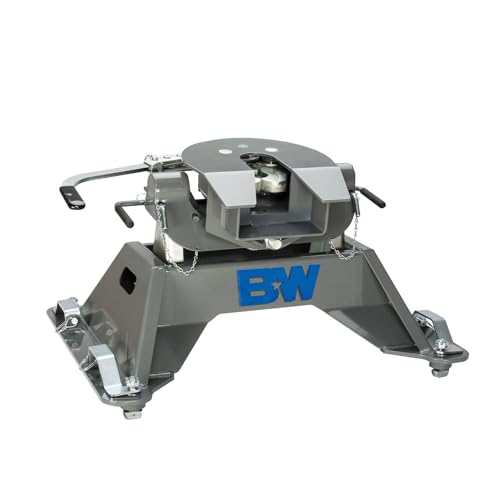
Designed for GM OEM puck systems, this 25K Companion hitch delivers a fully articulating head for precise alignment and front-to-back as well as side-to-side pivoting. The cam action latching handle facilitates secure attachment and release, including on uneven or unlevel sites. It integrates smoothly with factory truck configurations to provide a solid, user-friendly towing experience.
B&W 25K Companion OEM Fifth Wheel Hitch RVK3305

Perfect for Ford OEM puck systems, this heavy-duty hitch offers a fully articulating head to accommodate varied towing conditions. The cam action latching handle ensures straightforward operation on diverse sites, while the overall construction emphasizes durability and secure coupling, essential for flatbed applications with fluctuating loads.
Reese 30119 Fifth Wheel Hitch

Reese 30119 offers a robust 20,000-pound towing capacity with a dual jaw locking system that surrounds the king pin for reduced wear. It features a wide-stance one-piece leg design and side-to-side pivot action to better accommodate uneven hookups, along with straightforward installation. The system supports a combination of front-to-back pivot up to 44 degrees and side-to-side pivot up to 5 degrees for versatile towing on flatbeds.
Andersen Gen 3 Ultimate Fifth Wheel Connection

Andersen Gen 3 Ultimate offers a lightweight yet strong solution, weighing only 37 lbs while supporting up to 24,000 lbs GTWR. It provides two height settings and a compact base with a 3-¼” offset for stability and storage. The patented remote latching system allows hitching and unhitching without climbing into the bed, beneficial for frequent campers or mobile setups on flatbeds.
Buying Guide
- Compatibility: Verify that the hitch is compatible with your flatbed configuration (OEM puck systems, Turnoverball adapters, or universal mounting). Some hitches are designed for specific truck brands or bed setups, especially with flatbed adapters.
- Articulation and Movement: A fully articulating head reduces hitching friction and improves alignment on uneven ground. Look for dual-pivot or wide pivot ranges if you frequently encounter irregular hookup angles.
- Release Mechanism: Cam action latches and auto-lock features simplify attachment and release, particularly when working on unlevel surfaces. Remote latching can save time and effort.
- Noise and Vibration: Polyurethane bushings and anti-rattle features minimize noise and rattle, enhancing ride quality and reducing wear on pins and kingpins.
- Weight and Handling: Consider the overall weight of the hitch and whether the unit is easy to install, remove, or move. Lighter options with robust construction can be advantageous for DIY setups.
- Capacity and Fit: Match the hitch capacity with your load demands and trailer specifications. Overbuilding can be unnecessary, but under-sizing risks performance issues and safety.
- Installation Ease: Some hitches are designed for straightforward installation with minimal drilling or permanent modification, while others require more involved setup for a flatbed.
- Warranty and Support: Check warranty terms and availability of customer support. A solid warranty often indicates confidence in durability and service.
- Maintenance: Seek models with sealed or low-maintenance components to minimize upkeep, particularly in rugged or off-road environments common with flatbed work.
- Cost of Ownership: While price is a factor, consider long-term value, including ease of use, service availability, and the hitch’s service life in your typical towing scenarios.
Note: This article presents information based on listed features and common use cases. Always consult the manufacturer’s specifications and your vehicle’s load ratings before making a purchase.