When you’re traveling, road-tripping, or living an on-the-go lifestyle, a reliable car inverter charger turns your vehicle into a flexible power station. The right unit converts 12V DC from your cigarette lighter into 110V AC for laptops, tablets, cameras, CPAP machines, and more. This guide highlights durable, multi-port inverters with built-in protection and smart cooling. Below, you’ll find five strong options, each chosen for balance between portability, power, and features.
Summary of Selected Products:
| Product | Brand | Continuous Power | USB Ports | Notable Features |
|---|---|---|---|---|
| 200W Car Power Inverter (PiSFAU) | PiSFAU | 200W | 4 USB ports + 2 AC outlets | Compact, quiet operation, multiple USB-C fast charging |
| 200W Car Power Inverter (FOVAL) | FOVAL | 200W | 4 USB ports | Smart cooling fan, portable size |
| 400W Car Power Inverter (Pro Chaser) | Pro Chaser | 400W | Dual USB ports | Dual AC outlets, long cord, high peak power |
| 200W Power Inverter (BESTEK) | BESTEK | 200W | 2 USB (including USB-C PD) + 2 AC outlets | PD USB-C and QC charging, 5-in-1 design |
| 150W Car Power Inverter (PiSFAU) | PiSFAU | 150W | 2 USB ports | Compact and budget-friendly option |
PiSFAU 200W Car Power Inverter

The PiSFAU 200W unit delivers 200 watts of continuous DC to AC power with multiple charging ports. It features 2 US-standard AC outlets and 4 USB ports, including a USB-C option for fast charging. Its compact, lightweight form makes it suitable for everyday use in cars, trucks, or RVs, and it emphasizes quiet operation and efficient heat dissipation for extended use. This inverter is well-suited for charging laptops, tablets, phones, and other small electronics during travel.
FOVAL 200W Car Power Inverter
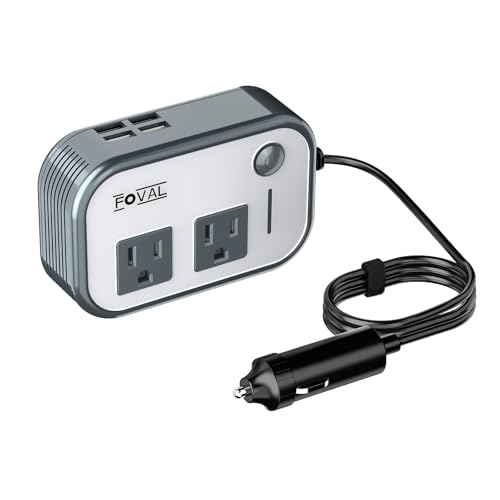
The FOVAL 200W inverter features dual AC outlets and four USB ports, supplying up to 180W total to AC devices. Its compact “travel kit” size makes it easy to store in the vehicle, while a built-in smart cooling fan manages heat during longer use. It’s designed for charging laptops, tablets, phones, and other electronics on road trips, camping trips, or in daily commutes where portable power is needed between outlets.
Pro Chaser 400W Power Inverter

The Pro Chaser inverter provides a robust 400W continuous power with a peak of 800W. It includes dual 110V AC outlets and two high-speed USB ports for fast charging, plus a long 30-inch cord for flexible placement. With multiple USB charging options, it’s well-suited for laptops, cameras, game consoles, and other devices on longer trips or family travel where multiple devices must be powered at once.
BESTEK 200W Power Inverter

The BESTEK 200W inverter balances PD USB-C and QC USB-A fast charging with two AC outlets. It also includes a USB-C PD port delivering up to 30W and a QC 18W USB-A port, enabling simultaneous fast charging of multiple devices. The 24-inch cord helps place the unit out of the way in the vehicle, while its 5-in-1 design supports a range of charging needs for laptops, tablets, and smaller electronics on the go.
PiSFAU 150W Power Inverter

The 150W PiSFAU unit provides a compact option for lighter loads. It includes dual USB ports for charging and two AC outlets for essential devices. Its smaller footprint makes it a practical choice for budget-conscious users who need reliable power for intermittent use during daily commutes or short trips, without adding much bulk to the vehicle cockpit.
Buying Guide: Key Purchase Considerations
Power needs matter most. Consider continuous wattage (the power you can draw consistently) versus peak wattage (the power the inverter can deliver in brief bursts). For laptops or CPAP machines, aim for an inverter with at least 200W continuous power or higher if you plan to run multiple devices.
Outlets and ports balance. Most inverters offer a mix of AC outlets and USB ports. USB-C PD ports are increasingly common for faster laptop charging. If you frequently charge multiple devices, prioritize units with more USB ports and at least one USB-C PD port.
Safety and protection features. Look for short-circuit protection, over-voltage and under-voltage protection, over-temperature protection, and a built-in fuse. Some units also include smart IC charging to optimize device compatibility and prevent damage.
Cooling and noise. A quiet cooling fan is important for longer use, particularly in hot weather or when the inverter sits in a small car cabin. Some models demonstrate better thermal management and lower noise in practice.
Portability and build. Compact, lightweight designs are easier to stash in a glove box or under a seat. Aluminum or metal shells can offer durability, while a longer power cord provides flexible placement options.
Size, weight, and footprint. If space is limited, prioritize smaller units with sufficient power for your typical devices. For extended road trips, a larger inverter with more ports may be worth the extra bulk.
Usage scenario variations. If you’re powering high-wattage devices (like CPAP machines or laptops) during travel, choose an inverter with ample continuous power and robust cooling. For casual charging or emergency use, a smaller, budget-friendly model may suffice.
Warranty and support. Consider brands that provide a reasonable warranty and accessible customer support. This can be helpful if you encounter boot-up issues or reliability questions during trips.
Price versus performance. While high-wattage, feature-rich models deliver versatility, ensure the inverter suits your typical load. A balance of power, protection, and portability often yields the best long-term value.
All selected models in this guide meet common safety expectations for vehicle use and offer multiple charging options. When choosing, align the unit with your most frequent devices, space constraints, and how often you’ll rely on it during travel.