Choosing a low profile, low-entry trolley jack helps you lift sedans, sports cars, and compact SUVs with ease. The following selections offer quick lifting options, overload protection, and stable saddles to protect your vehicle’s underside. Each entry focuses on a compact, sturdy design suitable for standard passenger cars and light-duty tasks. Below is a quick table of the featured models to compare at a glance.
| Product | Brand | Capacity | Lifting Range | Link |
|---|---|---|---|---|
| DNA Motoring TOOLS-00234 Low Profile Hydraulic Trolley | DNA Motoring | 2 Ton (4000 lbs) | 5.1″ – 13″ | Amazon |
| TONDA Low Profile Car Jack | TONDA | 2.5 Ton (5000 lbs) | 3.35″ – 14.57″ | Amazon |
| VEVOR 2.5 Ton Low Profile Floor Jack | VEVOR | 2.5 Ton (5500 lbs) | 3.35″ – 14.96″ | Amazon |
| Sealey 1020Leb 2 Ton Low Entry Short Chassis | Sealey | 2 Ton | ~3.5″ – 85mm | Amazon |
| DNA Motoring TOOLS-00676-RD 2.5 Ton | DNA Motoring | 2.5 Ton (5500 lbs) | 3.35″ – 15.16″ | Amazon |
These selections provide a range of capacities and lifting heights, with several models optimized for tight garages, light-to-mid vehicle maintenance, and easy maneuverability around the shop floor. Read on to see full details for each model and how they stack up against common low-clearance lifting needs.
DNA Motoring TOOLS-00234 Low Profile Jack
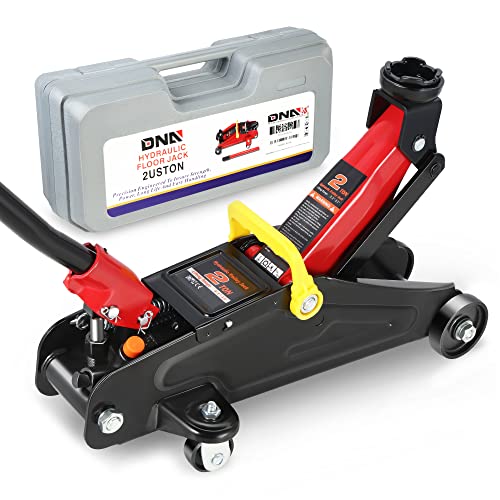
Capacity: 2 tons (4000 lbs) with a lifting range of 5.1″ to 13″. The jack uses a hydraulic piston to raise the saddle, supporting most passenger cars in routine maintenance tasks. A large saddle adds stability, helping protect the vehicle’s pinch welds and undercarriage during lifts. Overload protection via a safety valve helps prevent accidental damage if applied load exceeds capacity. The unit’s steel construction emphasizes rigidity and durability, while swivel casters support smooth maneuverability around the shop or driveway. Best for standard sedans and compact SUVs within the 4,000-lb range.
Key considerations include: ensure the vehicle weight remains within the 4,000-lb capacity, verify ground clearance before lifting, and use wheel chocks to secure the vehicle after lifting. This model is not recommended for heavy pickups or large trucks due to lower maximum height and weight limits. The design emphasizes quick setup and stable lifting with easy positioning at the saddle.
TONDA Low Profile Car Jack, 2.5 Ton

This 2.5-ton floor jack provides a lifting range from 3.35″ to 14.57″, enabling work on lower-stance cars and many crossovers. The combination of a wide lifting range and sturdy steel construction yields improved stability during lifts, while two large rear casters and two 360-degree swivel casters maximize mobility in tight spaces. The detachable long handle makes transport and storage straightforward. This jack suits garages that service family sedans and small SUVs, offering reliable lifting performance without excessive bulk.
Critical notes include reviewing the vehicle’s curb weight, confirming compatible lifting points, and ensuring the handle is securely attached before use. While highly versatile, users should avoid lifting vehicles beyond the rated capacity to prevent undue stress on the hydraulic system and chassis.
VEVOR 2.5 Ton Low Profile Floor Jack
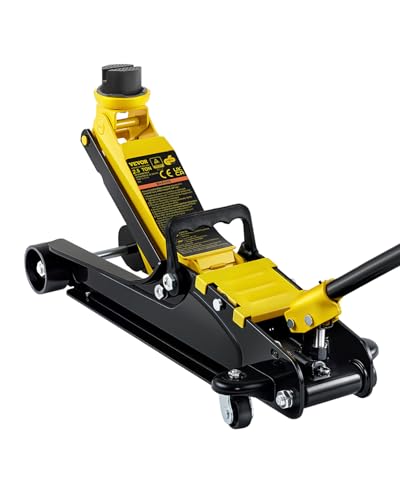
VEVOR’s 2.5-ton jack offers a lifting range of 3.35″ to 14.96″ with a sturdy single-piston hydraulic design. The heavy-strength steel construction emphasizes durability, while the two rear universal steel wheels and top handle support easy maneuverability and precise positioning. The long handle and wide saddle simplify alignment under the vehicle, making it suitable for routine tire changes, brake maintenance, and oil service on family cars, SUVs, and some light trucks. It is a practical option for DIY enthusiasts seeking extended height reach in a low-profile frame.
Considerations include checking for proper lubrication of the pump, using base plates or casters on uneven ground, and monitoring the saddle contact to avoid scratching the vehicle. Do not exceed the tool’s maximum rated capacity during use.
Sealey 1020Leb 2 Ton Low Entry Short Chassis

With a low chassis and a short profile, the Sealey 1020Leb achieves a low clearance height around 85mm (3.35 inches). It’s designed for sports cars and vehicles with limited undercarriage clearance. The unit features a profiled lifting arm to maintain stability and an overload valve for added protection, along with a carry handle for safe transport. The build focuses on torsional rigidity under load, ensuring reliable lifting during maintenance tasks such as tire changes, brake work, or suspension checks on cars with tight wheel arches.
Practical considerations include ensuring proper surface support, using wheel chocks, and confirming compatible lifting points to avoid damage to the pinch welds or chassis. Its compact design makes it a strong option for garages that frequently work on lower-clearance vehicles.
DNA Motoring TOOLS-00676-RD 2.5 Ton Jack

This 2.5-ton jack offers a lifting range from 3.35″ to 15.16″, blending a robust lifting capacity with a relatively low entry. The safety valve provides overload protection, and the saddle is designed to stabilize the vehicle during lifting. The model emphasizes rapid lifting suitable for garage service and heavy-duty tasks, with a focus on reliable operation for common passenger cars and light trucks. The red finish helps with visibility in busy shop environments.
Useful tips include verifying the jack’s weight rating against the vehicle, keeping the jack on a flat, solid surface, and using the included saddle contact points to distribute force evenly. This model is well-suited for frequent tire changes and routine maintenance where extra height is beneficial.
Buying Guide: Key Considerations For Choosing A Low Entry Trolley Jack
- Capacity: Match the jack’s weight rating to your vehicle’s curb weight plus some safety margin. For most sedans, 2-2.5 tons is sufficient; for light trucks or SUVs, consider 2.5-3 tons if available.
- Low Clearance Height: A lower minimum lift height helps with sports cars and compact sedans. Check the minimum height and how that affects your undercarriage access.
- Lifting Range: A broad range (minimum to maximum) provides versatility for different vehicles and tasks, such as tire changes or brake maintenance.
- Stability and Saddle Design: A large saddle and wide base improve stability and protect pinch welds. Ensure the saddle aligns with your vehicle’s lifting points.
- Construction and Durability: Look for heavy-duty steel construction, quality welds, and corrosion resistance if you often work in humid or damp environments.
- Mobility: Swivel casters and a long handle facilitate moving the jack around the garage; consider models with two swiveling front casters for directional control.
- Overload Protection: An integrated safety release valve helps prevent accidental overload, reducing risk of damage or injury during use.
- Maintenance: Regularly inspect hydraulic oil, seals, and wheels. Lubrication and cleaning extend service life and performance.
- Usage Environment: Choose a unit suited to your space—narrow garages benefit from compact chassis; larger workshops may leverage higher lift variants.
The right low-entry trolley jack combines capacity, stability, and maneuverability to fit your vehicle profile and garage layout. When comparing models, prioritize lift height versatility, ease of use, and protective features that preserve both the tool and your vehicle during service tasks.