Choosing a natural gas conversion kit for your generator can expand your fueling options, increase resilience during outages, and reduce fuel storage needs. This article examines five widely used kits designed to convert common portable and standby generators to run on natural gas or propane, without permanent modification to your engine. We compare compatibility, installation considerations, and operational notes to help you select a kit that fits your generator model and your preferred fuel strategy.
| Product | Brand | Approx. Compatibility | Notes |
|---|---|---|---|
| Natural Gas Conversion Kit Compatible with Duromax XP12000EH | Generic | Duromax XP12000EH | Low-pressure natural gas inlet; retains gasoline option |
| YAMAKATO 389cc 420cc Tri Dual Fuel Kit | YAMAKATO | Honda/GX series and various clone engines | Tri fuel capability; broad OEM-style fit |
| Natural Gas Conversion Kit fits Westinghouse WGEN9500DF | GENERIC | Westinghouse WGEN9500DF | Non-permanent modification; gasoline retained |
| New Manual Choke Dual Fuel Carburetor LPG NG Kit 4.5-5.5KW GX390 | LEIMO KPARTS | GX390 188F engines; 4.5-5.5KW output | Dual-fuel carb with LPG/CNG conversion |
| YAMAKATO Dual Tri Fuel Carburetor for Predator/Champion/GX engines | YAMAKATO | Predator, Champion, Generac, Honda GX variants | Tri-fuel carburetor for multiple brands |
Natural Gas Conversion Kit for Duromax XP12000EH

This kit is designed to adapt a Duromax XP12000EH to operate on low-pressure natural gas while preserving the original gasoline capability. The installation uses an existing carburetor port for the natural gas inlet and does not require permanent engine modification. When you want to switch back to gasoline, you simply reconnect the stock propane hose if needed, ensuring flexibility across fuel types. The kit targets low-pressure natural gas systems and emphasizes compatibility with the XP12000EH model, enabling a practical transition for users with access to natural gas lines.
Key considerations include ensuring your natural gas supply meets the low-pressure requirements and confirming that the kit’s port fitment aligns with your carburetor. While it preserves the generator’s ability to run on gasoline, field testing is essential to verify stable idle and peak performance on natural gas, particularly under load. Users should follow manufacturer directions for installation to avoid leaks or fuel delivery issues.
Operational notes emphasize that natural gas tends to have a different energy content than gasoline, which can affect running times and load management. If you anticipate frequent transitions between fuels, document your maintenance routine and monitor fuel pressure and regulator performance to maintain consistent combustion. The kit’s non-permanent nature makes it attractive for users who want a reversible solution without sealing or drilling into critical components.
YAMAKATO 389cc Tri Dual Fuel Kit

The YAMAKATO Tri Dual Fuel Kit offers a multi-fuel approach, enabling gas-to-LPG or CNG transitions across several engine displacements, including GX270, GX340, GX390 and variants used by Generac, Champion, and other major brands. It’s designed as a carburetor replacement rather than a permanent engine modification, and it ships with mounting gaskets (non-asbestos) for OEM-quality installation. The kit is intended to cover a wide range of generators and is marketed for compatibility with various brands and clones, including some Honda GX engines and Generac GP series.
Engine compatibility is broad, but users should verify that their specific model matches the listed displacement and carburetor format. The kit’s emphasis on OEM-standard mounting and gasket quality helps with sealing and durability. Potential considerations include ensuring proper fuel pressure and regulator settings for natural gas as well as the correct mixture for LPG when using propane. As with any carburetor upgrade, tuning may be necessary to optimize idle, throttle response, and full-load performance across fuels.
In practice, this kit can simplify the transition from gasoline to natural gas or propane, allowing owners to choose the most economical or available fuel source. Given the extensive list of compatible brands and models, it’s important to confirm exact compatibility before ordering and to consult installation resources if you’re unfamiliar with carburetor replacements.
Natural Gas Conversion Kit for Westinghouse WGEN9500DF

This conversion kit targets the Westinghouse WGEN9500DF, offering a non-permanent modification path that preserves the ability to switch back to gasoline. By using the natural gas inlet port integrated into the carburetor, the kit minimizes invasive changes while enabling operation on natural gas. An emphasis on reversible installation makes it suitable for homeowners who want fuel flexibility without voiding warranty terms or performing irreversible engine work.
Key considerations include verifying the natural gas pressure requirements and ensuring compatibility with the WGEN9500DF’s carburetor layout. The kit’s design should maintain a reliable supply of gas at proper pressure to support stable engine operation. As with other carburetor-based conversions, users should monitor engine performance under load and verify that the transition between fuels remains smooth and dependable during critical generator use scenarios.
LEIMO KPARTS Manual Choke Dual Fuel Kit for GX390

The LEIMO KPARTS dual fuel carburetor kit is designed for GX390 class engines, covering 4.5-5.5KW output. It enables LPG/CNG conversion alongside existing gasoline operation, providing a practical path to dual-fuel performance for small to mid-size generators. The kit includes a manual choke mechanism, which can simplify startup in colder conditions or when transitioning between fuels. It targets a broad range of GX390-based generators, making it a versatile option for users with GX390 or compatible GX-series engines.
Important installation considerations include ensuring proper mounting and gasket sealing to prevent air leaks, as well as calibrating the carburetor for accurate fuel-air mixture across fuels. Consideration should also be given to fuel pressure stability and regulator compatibility with LPG and CNG sources. As with any carburetor-based conversion, performance can vary with engine size, altitude, and load, so plan for a possible tuning step after installation to achieve peak stability and efficiency.
YAMAKATO Dual Tri Fuel Carburetor for Predator/Champion

This YAMAKATO kit focuses on tri-fuel carburetor configurations suitable for Predator, Champion, and various Generac and GX engine models. It is marketed for dual-fuel and tri-fuel operation, enabling natural gas, propane, and gasoline usage depending on the installation. The model list includes multiple Honda GX variants and clone engines, as well as Generac GP-series and Champion units. The kit ships with mounting gaskets described as non-asbestos for compatibility and safety reasons.
When considering this kit, assess your generator’s displacement and carburetor type to confirm fitment. Tri-fuel systems can offer broader fueling flexibility but may require more careful tuning to achieve consistent combustion across gas sources and different octane ratings. Users should be prepared for potential calibration changes when switching fuels, especially under heavy load or high-altitude conditions. The broad compatibility can be a benefit, yet precise identification of your unit’s model is essential before purchasing.
KELKONG GX390 LPG/NG Carburetor Dual Fuel Kit
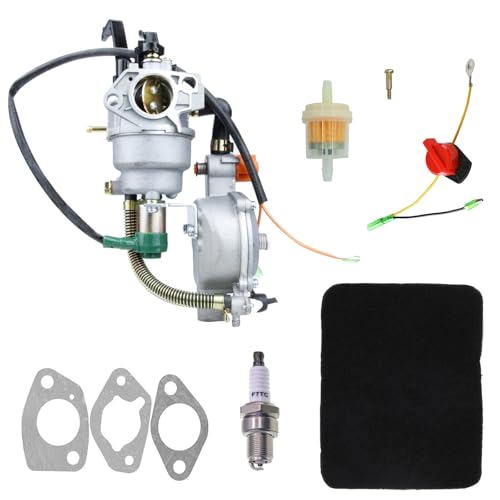
The KELKONG GX390 kit targets a wide engine range, including Predator, 8500/8750/7000/9000 series and Honda GX270/340/390 engines. It is positioned as a dual-fuel carburetor kit compatible with a broad set of Generac, WH-series, and Champion generators. The design emphasizes safety and structural integrity, aiming to maintain safe operation during fuel transitions. This kit is especially suitable for owners who need a robust, all-in-one carburetor solution for multiple brands within the GX390 and nearby displacement families.
Installation considerations include verifying compatibility with your engine displacement, carburetor mounting, and fuel regulator settings for LPG/NG use. The safety-oriented design suggests attention to proper mounting and seal integrity to prevent leaks. As with other carburetor conversions, expect some tuning to optimize idle and full-load performance when switching among gasoline, natural gas, and LPG, and confirm that the unit remains within safe operating temperatures under continuous use.
18FT Natural Gas Hose With Quick Connect

This hose is designed to enable outdoor natural gas and propane connections for grills, heaters, and generators, featuring multiple adapters and a CSA-certified build. The 18-foot length provides flexibility for arranging appliances while maintaining low-pressure natural gas operation. The kit includes five adapter types and multiple fittings to accommodate a range of connection schemes, including quick-connect layouts. The materials emphasize brass fittings for durability and a rubber hose construction suitable for outdoor use and resistance to aging and weather exposure.
Practical usage notes include ensuring proper pressure ratings (11 inches of water column, about 0.5 psi) and verifying that all adapters are securely tightened to prevent leaks. This hose is intended to support conversion setups rather than a standalone fuel source, so it pairs with appropriate regulators and fuel delivery components as part of a full conversion kit. Regular inspections for wear, cracking, or leaks will help maintain safe operation during generator use.
Nature Gas Propane Carburetor Conversion Kit

Compatible with Predator Harbor Freight 3200-4000 watt generators, this ALLMOST kit focuses on converting existing carburetors for natural gas and propane operation. The package includes a carburetor assembly and gaskets, providing a straightforward replacement option to enable gas-fueled operation. It emphasizes ease of installation and reliable operation after conversion, aiming to maintain compatibility with the generator’s original design.
Key considerations include ensuring correct gasket fitment and mounting orientation to avoid air leaks. Compatibility with the specific Predator Harbor Freight models should be verified, as engine configurations vary across generations. After installation, owners should test the unit at partial and full load to validate smooth transitions between fuels, and monitor for any fuel delivery anomalies that could impact performance or safety.
Buying Guide: Key Purchase Considerations
- Engine compatibility: Confirm your generator’s exact model, displacement, and carburetor type before purchasing any kit. Even within a brand, variations can affect fitment and performance.
- Fuel type and pressure: Natural gas uses low-pressure lines; ensure your local gas supply meets the kit’s pressure requirements and that you have a compatible regulator or manifold.
- Non-permanent modifications: If you prefer reversible changes, prioritize kits advertised as non-permanent or that preserve the ability to revert to gasoline with minimal steps.
- Gasket and mounting quality: Non-asbestos or OEM-standard gaskets improve sealing and durability, reducing leakage risk during operation.
- Tuning and calibration: Expect a potential tuning step after installation to optimize air-fuel ratios for each fuel type, especially under load or altitude changes.
- Regulatory and safety considerations: Use CSA-certified hoses and ensure all fittings are rated for the system pressure. Check for leaks after installation using approved methods.
- Warranty and maintenance: Some conversions may affect warranty terms; review the manufacturer’s policy and plan for regular maintenance checks on the carburetor and fuel lines.
- Installation complexity: Some kits require mechanical skills (carburetor replacement, gasket sealing, fuel line routing). If unsure, seek professional help to minimize risk of gas leaks or engine damage.