Choosing an OBD1 scan tool for older GM and Ford vehicles requires understanding compatibility, ease of use, and what each device can read. This guide highlights five reliable options designed to read ECM and ABS codes from the 1982–1995 era, with practical notes on compatibility, display features, and diagnostic capabilities. Each product section includes a direct link to Amazon for quick access, along with a concise overview of key features to help you compare at a glance.
| Product | Brand |
|---|---|
| JOPLAY OBD1 Scanner (GM 1982–1995) | Joplay |
| INNOVA 3145 Ford Digital OBD1 Code Reader | Innova |
| JOPLAY OBD1 Code Reader (Ford 1981–1995) | Joplay |
| INNOVA 3123 GM OBD1 Code Reader | Innova |
| JOPLAY GM OBD1 Code Reader (Blue) | Joplay |
Note: This overview prioritizes devices that provide direct ECM/ABS code reading, compatibility with MCU/EEC-IV systems where applicable, and user-friendly interfaces such as LCD screens or guided prompts. Always confirm the specific Make/Model compatibility on the product page before purchase, especially for model-specific limitations or exclusions.
JOPLAY OBD1 Scanner GM 1982–1995 (Blue)
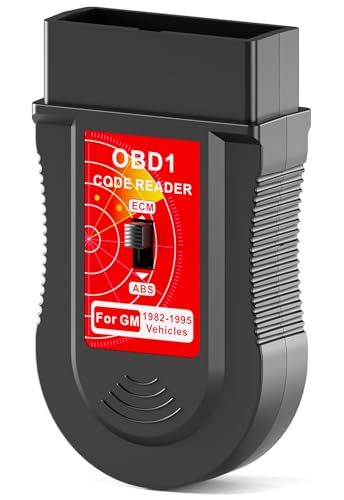
This OBD1 tool is designed for General Motors and Saturn models from 1982 to 1995. It uses a professional connector to minimize the risk of short circuits, acting as a safe alternative to improvised jumper wires. The device provides dashboard indicator guidance as you perform checks and includes printed instructions in multiple languages (English, Spanish, and French) to assist with troubleshooting. It specifically targets ECM and ABS codes while warning that it does not read codes on certain non-supported vehicles (diesel, Cadillac, Geo, Nova, Toyota 4Runner, Sprint variants). Users connect directly to the vehicle’s self-test connector to access the on-board computer. The unit emphasizes safety and compatibility, aiming to prevent damage to vehicle electronics during diagnostics.
Key considerations:
– Safe, professional connection rather than DIY jumpers.
– Broad GM compatibility within the 1982–1995 window.
– Multilingual guidance to assist non-English speakers or learners.
– Clear limitations on non-supported models to avoid misdiagnosis.
INNOVA 3145 Ford Digital OBD1 Code Reader
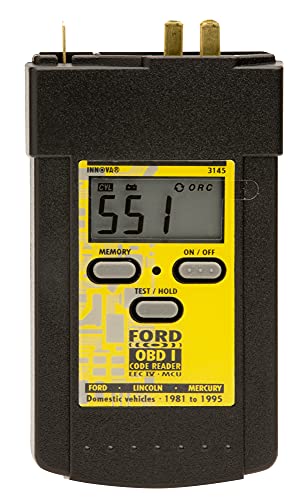
The INNOVA 3145 is a Ford-focused digital OBD1 code reader designed for various Ford, Lincoln, and Mercury vehicles manufactured between 1982 and 1995. It features an easy-to-view numeric display that streamlines troubleshooting by presenting trouble codes without counting flashes. The device is compatible with MCU and EEC-IV computer control systems, providing straightforward access to diagnostic data. While its emphasis is Ford-friendly, it is a dependable option for owners seeking a simple, digital readout of OBD1 codes rather than a flash-based indicator method. It connects to the vehicle’s self-test connector for safe data retrieval while preserving vehicle electronics integrity.
Key considerations:
– Clear numeric code display eliminates guesswork.
– Targeted support for Ford-family vehicles and legacy control systems.
– Straightforward operation with basic diagnostic access.
– Limited to Ford-era OBD1 protocols; not a universal readout device.
JOPLAY OBD1 Code Reader Ford (2 in 1)

This 2-in-1 JOPLAY OBD1 code reader is designed for Ford, Lincoln, and Mercury models from 1981 to 1995. It uses reinforced pins and a 9-foot cable, supporting EEC-IV and MCU-based systems. The device includes a 2.4-inch LCD that instantly displays code numbers along with their definitions, reducing the need to interpret blinking codes or consult manuals. It offers three diagnostic modes—Key On Engine Off (KOEO), Continuous Memory (CM), and Key On Engine Running (KOER)—to help technicians perform comprehensive self-tests. Note that ABS codes are not supported by this model.
Key considerations:
– Wide Ford-family compatibility with digital code display.
– Self-test modes help isolate issues without cam- or crank-related errors.
– Longer cable with reinforced pins for durability and flexibility.
– Not a universal tool; ABS-code capabilities are limited on this unit.
INNOVA 3123 GM OBD1 Code Reader
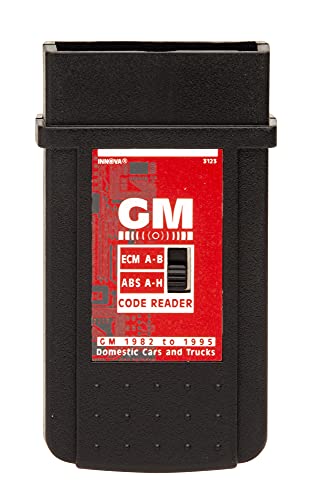
The INNOVA 3123 GM OBD1 Code Reader is tailored for General Motors vehicles from 1982 to 1995. It safely interfaces with the vehicle’s ECM and ABS systems via the self-test connector, enabling readouts of codes in a straightforward manner. The tool emphasizes safe electronic access to diagnostic information, supporting GM’s on-board computer architecture of the era. It is a practical option for owners or shops servicing a broad range of GM passenger cars and light trucks from the early OBD1 period.
Key considerations:
– GM-specific compatibility across a wide range of models.
– Safe, direct access to ECM and ABS codes.
– Simple plug-and-diagnose workflow.
– Not intended for non-GM or non-OBD1 vehicles; limited cross-compatibility.
JOPLAY OBD1 Scanner GM 1982–1995 (Blue)
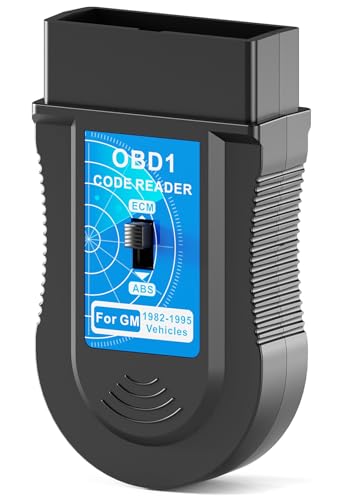
This blue variant of the JOPLAY OBD1 scanner focuses on General Motors vehicles from 1982 to 1995, mirroring the safety-first approach with a professional connector to prevent short circuits. It provides dashboard feedback to guide users through code counting and troubleshooting. The pack includes comprehensive instructions in multiple languages (English, Spanish, French) to facilitate use across diverse owners and technicians. As with other GM-focused OBD1 tools, it is designed for compatibility with specific GM models during the mid-1980s to mid-1990s window and does not cover non-GM or modern VIN-specific systems. It emphasizes ease of use and reliability for classic GM diagnostics.
Key considerations:
– Multilingual instructions for broader accessibility.
– Safe connection method to minimize risk to vehicle electronics.
– Clear guidance on compatible GM models within the target years.
– Limited to GM vehicles and OBD1-era diagnostics.
Buying Guide: Key Considerations For Choosing An OBD1 Tool
- Vehicle compatibility: Confirm that the tool supports your make (GM or Ford) and year range (1982–1995). Some models exclude diesel engines or certain sub-lines; always check the product page for exact coverage.
- Reading capabilities: Determine whether the tool reads ECM and ABS codes, and whether it provides digital code definitions or requires manual interpretation of blinking indicators.
- Display and usability: LCD displays and user-friendly interfaces reduce diagnostic time. Tools with KOEO/KOER/CM tests provide more comprehensive self-diagnosis options.
- Safety and reliability: Look for professional connectors and rugged build materials that minimize the risk of short circuits or damaging the vehicle’s electronics.
- Language and documentation: Multilingual instructions or clearly written guides help users who are non-native English speakers or new to OBD1 diagnostics.
- Cable length and build: Long cables and reinforced pins increase flexibility when accessing the vehicle’s diagnostic connector in tight engine bays or unconventional layouts.
- Future-proof considerations: While these tools target older vehicles, some models offer better compatibility across a broader range of 1982–1995 GM and Ford vehicles, which can be helpful for collectors or repair shops specializing in classic cars.
Additional Considerations: Use Scenarios And Depth Of Diagnostic Capability
- Daily maintenance for classic GM and Ford vehicles often benefits from a dedicated OBD1 reader with a clear code display, enabling quick verification of typical issues like sensor faults, wiring problems, or ECM/ABS code presence.
- Shops servicing mixed fleets including late-80s to mid-90s GM and Ford vehicles can benefit from multi-brand OBD1 tools that cover both brands, while recognizing model-specific limitations.
- For enthusiasts and hobbyists, ease of use, multilingual support, and a durable design help sustain long-term usage across multiple projects with minimal downtime.