Choosing the right on-board air compressor kit for a truck involves balancing power, reliability, ease of installation, and compatibility with air springs, tires, and tools. This guide highlights five top options, detailing what makes them suitable for American truck owners who want consistent air pressure on the go. Each product section includes a quick overview of key features, typical use cases, and practical installation notes to help you pick the right fit for your vehicle and driving needs.
| Product | Key Use | Best For | Approx. Pressure Range |
|---|---|---|---|
| LLNSEAUTO Medium Duty Onboard Air System | Air Horns, light to moderate air tools | Versatile 150 PSI system with tank | Up to 150 PSI |
| maXpeedingrods On Board Air System Universal | Air springs, easy in-cab adjustments | Simple, quick inflation without external tanks | Up to 100 PSI |
| ARB CKMA12 On-Board Air Compressor | Air lockers, tire inflation | Durable, high-performance setup | Approximately 100–150 PSI (system dependent) |
| VIAIR 150 PSI High-Flow Kit | Air horns, tires, air tools | High flow, reliable power | Up to 150 PSI |
| Air Lift LoadController On-Board System | Air springs, ride control | Single-path control with gauge | Depends on kit, typically up to 150 PSI |
LLNSEAUTO Medium Duty Onboard Air System

The LLNSEAUTO kit combines a 12-volt compressor with a 2.5-gallon air tank, delivering up to 150 PSI. It includes a 22-inch braided air hose, a remote-mount air filter, mounting hardware, and a comprehensive port layout for flexible plumbing. The system is designed for trucks requiring a compact, durable setup for horn operation or light pneumatic tools. Its 33% duty cycle at 100 PSI reflects typical use in short bursts, making it suitable for occasional tire topping and horn inflation in addition to air-spring assistance when paired with compatible components.
Key features include multiple NPT ports for expansion, a 180 PSI safety valve, a compact footprint, and a heavy-duty wiring harness with a 40-amp relay and inline fuse. This kit emphasizes straightforward installation and reliable performance in mobile environments, ideal for drivers who want a robust, all-in-one solution without extensive fabrication.
maXpeedingrods On Board Air System Universal Kit
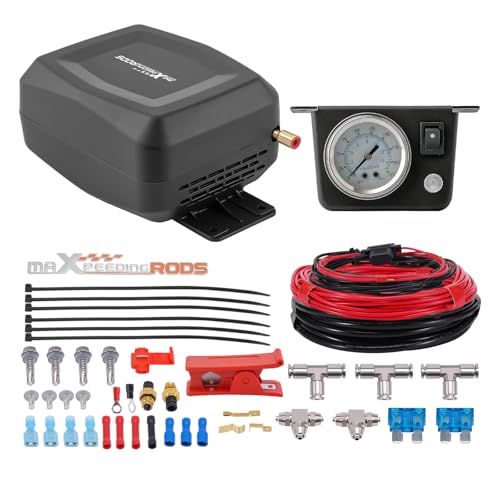
This universal air spring controller kit from maXpeedingrods is designed for quiet operation and ease of use. It features a durable on-board compressor with a maximum pressure of 100 psi, enabling reliable inflation of air springs for gains in stability and ride height under load. The system is designed to operate without a separate air tank in some configurations, allowing simultaneous inflation of both air bags via a single gauge button. It simplifies in-cab adjustments, enhancing ride quality for trucks carrying variable payloads or towing equipment.
Installation considerations include routing of the air line, ensuring proper electrical supply, and confirming compatibility with your vehicle’s air-bag layout. The kit emphasizes user-friendly operation, quick fill times, and practical control from inside the cab, making it a strong option for drivers seeking a balanced blend of convenience and performance.
ARB CKMA12 On-Board Air Compressor

ARB’s CKMA12 is a high-performance on-board compressor designed for demanding applications, including tire inflation and air locker systems. Constructed from lightweight engineering-grade materials, it emphasizes quiet operation and long life. The hard-anodized cylinder bore reduces friction, contributing to durability in rugged environments. This model is well-suited for drivers who anticipate frequent use under load, demanding inflation tasks, and systems requiring consistent air supply across varying temperatures and terrains.
Considerations include electrical requirements, mounting compatibility, and the need for a robust wiring loom and hose kit to complete a full air system. ARB’s reputation for automotive air systems helps ensure a dependable, long-term solution for serious off-road and work-truck setups.
Air Lift LoadController On-Board System

The Air Lift LoadController system focuses on ride height management with a heavy-duty compressor and an all-inclusive gauge for single-point control. It supports a single-path inflation approach, enabling uniform adjustment of an air spring setup. The kit is tailored for drivers who want straightforward, in-cab control over air pressure to maintain level loads, improve stability, and optimize handling on varying road surfaces. It is compatible with common air spring configurations and provides a practical solution for daily driving and towing scenarios.
Installation notes include ensuring a proper power source, mounting the compressor in a location with adequate cooling, and connecting the gauge and valves for reliable monitoring. This option suits users prioritizing an integrated, easy-to-use system with dependable performance for everyday truck operation.
Buying Guide: Key Purchase Considerations For On-Board Air Systems
When selecting an on-board air compressor for a truck, consider the following factors to ensure compatibility with your vehicle and intended use:
- Pressure Requirements: Match the maximum operating pressure to your needs (air springs, horns, tires, or tools). Higher PSI capacity is advantageous for heavy loads and aggressive tire tuning, but can come with heavier duty hardware and power demands.
- Tank vs Tankless Configurations: Tank-equipped kits store compressed air for quick bursts, while tankless designs rely on continuous pumping. Tanks add mass but improve recovery times and consistency for multiple inflation tasks.
- Duty Cycle and Heat Management: Look for the duty cycle rating (how long the unit can run before overheating) and cooling provisions. Trucks often operate in hot climates, so better heat dissipation extends life and reliability.
- Electrical Load and Wiring: Check amperage draw and ensure the vehicle electrical system (fuse/relay, wiring gauge) can handle peak power without draining the battery during operation.
- Port Availability and Plumbing: A multi-port manifold and ample NPT ports simplify installation, expansion, and future upgrades (additional hoses, gauges, or air tools).
- Size and Mounting: Consider space in the engine bay or underbody, vibration resistance, and mounting hardware. A compact, well-fitted unit reduces vibration and noise while improving reliability.
- Noise Levels: Some units operate quietly, while others can be louder under load. For daily driving, noise tolerance matters, especially in cabins near the installation location.
- Brand and Support: Reputable brands with robust documentation, warranty support, and replacement parts simplify maintenance and long-term ownership.
How To Choose Based On Your Truck Use
- Light-duty use (air horns, small tools, occasional tire topping): A compact 12V system with a modest tank and multiple ports is often sufficient.
- Heavier payloads or towing: Prioritize higher PSI capacity, reliable duty cycle, and a robust compressor with good cooling and wiring options.
- Air springs and ride height control: Look for a kit designed to balance pressure across multiple lines or a kit that includes a gauge and easy-to-use in-cab controls.
- Off-road or work-truck scenarios: Favor systems with hard-anodized components, durable housings, long service life, and added protection against dust and moisture.
All five highlighted options provide distinct advantages. Your choice should align with the expected load, driving environment, and whether you prioritize integrated controls, tank storage, or the sheer flow rate for rapid inflation. By evaluating duty cycles, PSI ranges, and installation flexibility, you can select a system that delivers reliable on-board air performance across daily commuting, towing, and work-site tasks.