Finding a safe, engaging remote-controlled car for a 1-year-old or toddler can be challenging. This guide highlights five beginner-friendly options that emphasize simple controls, bright visuals, and durable design. Each pick is tailored for early learners, helping develop hand-eye coordination, motor skills, and cause-and-effect understanding. Below, explore quick-details and an in-depth look at what makes each model suitable for very young riders.
| Product | Brand | Age Range | Key Features |
|---|---|---|---|
| Liberty Imports My First Cartoon RC Car | Liberty Imports | 18 months+ | Two-button forward/reverse, steering wheel controller, simple operation |
| PREXTEX Cartoon RC Car 2-Pack | PREXTEX | 18 months+ | Two cars, two frequencies, two-button steering, lights and sounds |
| B. toys Rally Ripster RC Car | B. toys | 12+ months | Light-up toy, durable, easy-to-hold controller, room-to-room play |
| OMBU 2-Pack Remote Control Cars | OMBU | 18 months+ | Two cars, two remotes, lights and sounds, simple forward/reverse |
| AEROQUEST Remote Control Fire Truck | AEROQUEST | 2-6 years | 2.4G control, lights, sounds, small-hands friendly remote |
Liberty Imports My First Cartoon RC Car

Liberty Imports offers a beginner-friendly RC car designed for toddlers ages 18 months and up. Its two-button control and a steering-wheel-style launcher enable straightforward forward and reverse movements, with intuitive left/right turns. The design emphasizes safety and simplicity, letting very young drivers explore cause-and-effect as they nudge the vehicle along. The large, colorful exterior keeps attention focused, while the 2-channel remote helps kids understand basic navigation without overwhelming controls.
PREXTEX Cartoon RC Car – 2-Pack
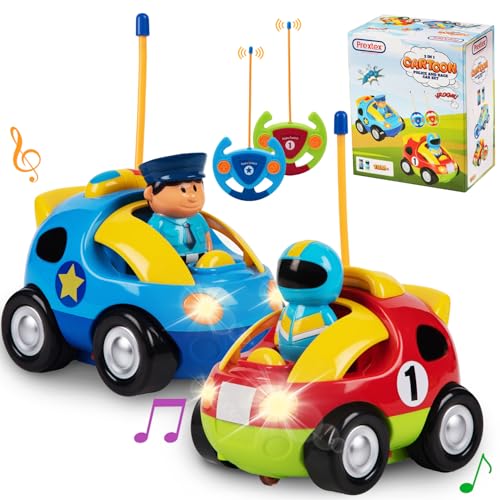
PREXTEX delivers a two-pack of kid-friendly RC cars with distinct frequencies to prevent interference during shared play. Each car uses a simple steering wheel-style controller with two buttons for forward and reverse motion, making it ideal for toddlers who are just starting to learn remote control. Features include honking sounds and bright headlights that engage sensory exploration, while the two-car setup supports cooperative play between siblings or friends.
B. toys Rally Ripster Remote Control Car

The Rally Ripster is designed for tiny hands with a compact, easy-to-grip controller and a toy car that lights up as it moves. It emphasizes simple forward motion and gentle turns, making it approachable for toddlers just learning to direct their vehicle. The built-in lights add a multi-sensory element that can help sustain a child’s interest during play and encourage imaginative storytelling around racing adventures.
OMBU 2-Pack Remote Control Cars

OMBU’s two-pack introduces a mini-race scenario with two distinct cars and remotes, promoting interactive play and cooperative competition. Designed for ages 18 months and up, the cars feature forward/reverse capabilities and engaging lights and sounds. The dual-car setup supports sibling or friend play, while the included batteries and simple operation help reduce setup friction for caregivers looking for stress-free entertainment.
AEROQUEST Remote Control Fire Truck

AEROQUEST offers a kid-friendly RC fire engine with a simplified 2.4G remote, designed for early learners ages 2 to 6. The vehicle features lights, sounds, and a user-friendly remote that fits small hands, enabling younger children to operate it with minimal effort. The interactive fire-rescue theme fosters imaginative play, as kids simulate emergency responses and motor skills development through deliberate movements.
Buying Guide: Key Factors for Selecting a Remote Car for Very Young Children
- Age appropriateness and safety: Choose models labeled for 18 months and up or 12 months and up, with large, easy-to-press buttons and non-slip grips. Look for sturdy construction and rounded edges to minimize injury risk.
- Controls simplicity: Prioritize devices with 1–2 control buttons, or steering wheel-like controllers designed for toddlers, to reduce cognitive load and encourage independent play.
- Durability and materials: Soft plastics, rounded corners, and impact-resistant exteriors help withstand inevitable drops and rough handling common with early learners.
- Visual appeal and learning value: Bright colors, lights, and sound effects can hold attention and support sensory development. Some models incorporate role-play themes (police, fire, racing) to spark storytelling.
- Age progression: Some cars are suitable for 18 months through 3 years or beyond, allowing a longer play life as motor skills improve. Consider products that scale with growing abilities.
- Battery and charging: Check battery life and charging time. USB-C or ambient charging options simplify recharging, while replaceable batteries can extend play time during longer sessions.
- Interference and shared play: For households with multiple children, models offering distinct frequencies or two-car packs reduce cross-talk and support cooperative play.
- Maintenance and supervision: Look for easy-clean surfaces and simple teardown for quick wipe-downs after snack-time spills. Close supervision is advised for all remote toys around toddlers.
In assessing these options, the Liberty Imports, PREXTEX, B. toys, OMBU, and AEROQUEST picks each offer a balance of simple operation, observed safety considerations, and engaging design suitable for very young riders. Parents should weigh whether the child favors a light-up toy, a two-car setup for interactive play, or a themed vehicle that supports imaginative scenarios while developing early motor skills.
Additional Comparisons and Considerations
- Number of cars vs. single-car kits: Two-car packs support turn-taking and cooperative play, which can be beneficial for social development in preschool settings or shared play at home.
- Realism vs. toy-focused design: Some models lean into realistic features like sirens and authentic sounds, while others emphasize bright visuals and simple controls. Both approaches have developmental benefits, depending on the child’s interests.
- Remote control size and ergonomics: Look for controllers that fit a toddler’s hands comfortably and have clearly labeled buttons. Ergonomics influence how quickly a child can learn to operate the toy independently.
- Expansion potential: A few products permit future upgrades with additional cars or accessories, offering a longer-term play horizon as a child grows.
- Portability and storage: Compact designs are easier to store and transport, making them suitable for travel, daycare, or playdates.