Choosing the right smart trickle charger helps extend battery life, prevent sulfation, and ensure your vehicle starts reliably. This guide highlights five top options that balance automatic maintenance, temperature compensation, and compatibility with lead-acid and lithium batteries. Each product is designed for car owners who want a hands-off charging experience that protects their investments. Read on to compare features, operability, and practical use cases so you can pick the best charger for your needs.
| Product | Brand | Key Benefit |
|---|---|---|
| NOCO GENIUS1 | NOCO | Compact, versatile charger and desulfator with temperature compensation |
| NOCO GENIUS5 | NOCO | Higher power in a compact form for faster maintenance |
| NOCO GENIUS2 | NOCO | All-in-one charger with Force Mode for challenging batteries |
| NEXPEAK NC201 | NEXPEAK | 10-Amp/12V and 24V operation with robust fault protection |
| Foval Automatic Trickle Charger | FOVAL | Compact, 4-step charging and float maintenance for multiple battery chemistries |
NOCO GENIUS1: 1A Smart Maintainer

Engineered to handle 6V and 12V lead-acid and lithium batteries, the GENIUS1 functions as a charger, maintainer, trickle charger, and desulfator. Its compact size makes it suitable for space-constrained installations, while the integrated thermal sensor adjusts charging with ambient temperature. The device protects against overcharge and supports various battery chemistries, including flooded and VRLA types. This model emphasizes reliability for daily maintenance and seasonal storage alike, ensuring batteries remain at optimal voltage without manual intervention.
NOCO GENIUS5: 5A Smart Battery Charger
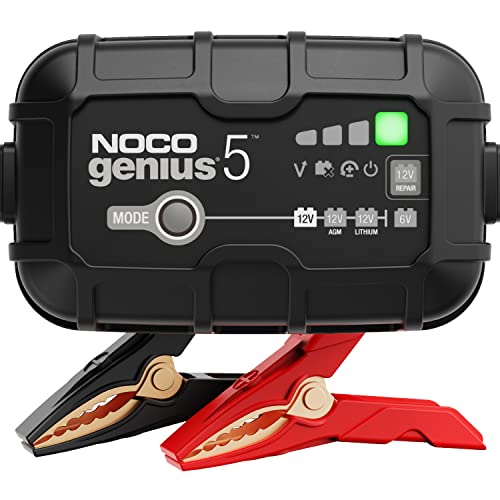
The GENIUS5 delivers more power in a compact footprint, offering faster charging and maintenance for 6V/12V lead-acid and lithium-ion batteries. Like its sibling models, it functions as a maintainer, trickle charger, and desulfator, with a temperature-compensated charge profile to prevent overheating or undercharging. It’s suitable for flooded, AGM, and deep-cycle batteries across marine, automotive, and powersport applications, making it a versatile choice for users with larger or multiple batteries.
NOCO GENIUS2: 2A Smart Charger

GENIUS2 is designed for flexibility, supporting lead-acid and lithium-ion batteries with an energy-efficient, high-performance profile. It can charge down to near-zero volts using Force Mode, allowing recovery of lightly discharged batteries before long-term degradation occurs. Its compact build makes it ideal for garages with limited space, and its charge optimization helps maintain battery health during periods of inactivity or seasonal storage. This model appeals to users who want a ready-to-use solution with robust performance in a small package.
NEXPEAK NC201 10-Amp Battery Charger

NC201 offers 10-amp charging with 12V/24V capability in a three-stage process that prioritizes speed without sacrificing battery health. It supports a wide range of lead-acid batteries, including AGM and flooded varieties used in cars, trucks, motorcycles, and marine equipment. The device also includes a trickle maintenance mode to counter self-discharge during long storage periods. Its safety features include multi-protection against short circuits and reverse polarity, making it suitable for DIY enthusiasts and professional garages alike.
Foval Automatic Trickle Battery Charger
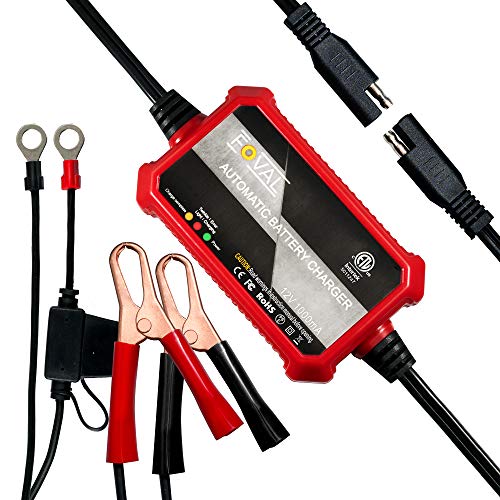
Foval’s charger provides a compact, automatic 1A 12V single-channel solution with a four-stage charging program: initialization, bulk, absorption, and float. It functions as a maintainer, trickle charger, float charger, and desulfator, aiming to extend battery life across a wide range of vehicles and equipment. The design emphasizes portability, with long cables and multiple connector options to fit cars, motorcycles, ATVs, boats, and more. It is well-suited for seasonal storage and routine maintenance, particularly for users who prefer a straightforward, all-in-one device.
Buying Guide: Key Purchase Considerations
- Battery type compatibility: Choose a charger that supports lead-acid, AGM, Gel, and lithium batteries if you own multiple vehicle types or batteries.
- Charge rate: Higher amperage (like 5A or 10A) charges faster and is better for larger or deeply discharged batteries, while 1A–2A units excel for routine maintenance and small batteries.
- Temperature compensation: Temperature sensing helps prevent overcharging in heat and undercharging in cold, preserving battery health.
- Desulfation and recovery: Desulfator features can restore some efficiency to older batteries, though results vary by battery condition.
- Maintenance vs. full charge: Look for automatic float maintenance to keep batteries topped off without risk of overcharging during long idle periods.
- Safety features: Overcurrent protection, short-circuit protection, reverse polarity safeguards, and fireproof housing add resilience for DIY users.
- Mounting options: Onboard or direct-mount chargers suit different vehicle configurations and space constraints.
- Ease of use: LCD indicators, clear modes, and automatic switching simplify operation, especially for casual users.
- Size and portability: Compact units are ideal for small spaces or portable setups, while larger units may provide faster charging.
- Brand ecosystem: Reputable brands with a history of reliability often provide better support and predictable performance across multiple models.
Multiple Perspectives to Consider
For seasonal storage, a compact 1A–2A charger with float mode offers peace of mind, protecting against self-discharge without the risk of overcharging. For garages with multiple vehicles or larger batteries, a 5A–10A model balances speed and maintenance without requiring constant supervision. If you want an installation-friendly option, onboard models that mount near the battery provide seamless integration for long-term setups. Finally, for users who want to revive older or deeply discharged batteries, models with Force or desulfation features may extend usable life, though results vary by battery condition.
In summary, the best smart trickle charger depends on your battery chemistry, storage needs, and how aggressively you want to maintain or recover battery capacity. The five models highlighted here cover common scenarios—from compact daily maintainers to higher-power options and onboard solutions—so you can select the one that aligns with your vehicle profile and maintenance routine.