Expanding away from shore power, savvy travelers rely on roof-mounted solar panels to keep campers, vans, and trucks powered. This guide highlights five highly compatible options for truck roof installations, focusing on compact size, durability, and efficient energy conversion. Each product is designed to fit tight roof lines, handle movement, and deliver steady power for camping gear, lights, and essential devices. Read on to compare performance factors, installation notes, and what to consider when choosing the best solar solution for your truck roof.
| Product | Brand | Key Benefit |
|---|---|---|
| Renogy 200W N-Type Solar Panel | Renogy | Compact 24V, high efficiency, lightweight design |
| Renogy 100W Flexible Solar Panel | Renogy | Ultra-flexible, curved surface compatibility |
| Eco-Worthy 200W Kit | ECO-WORTHY | Complete kit with PWM controller for RV and off-grid use |
| Renogy 200W ShadowFlux N-Type Panel | Renogy | Anti-shading technology for consistent output |
| Callsun 100W N-Type Mini Panel | Callsun | Compact 12V option with 16BB busbars for reliability |
Renogy 200W N-Type Solar Panel

Designed for Class B vans and other compact roof spaces, this 200W N-Type panel is 7.5% smaller and 11.7% lighter than previous models while maintaining the same power output. The 25% cell efficiency comes from advanced 16BB cell technology, improving energy conversion and reducing microcrack risks. Its 24V rating minimizes current losses and boosts system efficiency, enabling more usable energy even in less-than-ideal weather. The panel is compatible with both 12V and 24V battery systems, offering installation flexibility for RVs, campers, and boats where space is tight. Ideal for roof racks and limited headroom, it provides reliable daytime charging with a streamlined footprint.
Renogy 100W Flexible Solar Panel
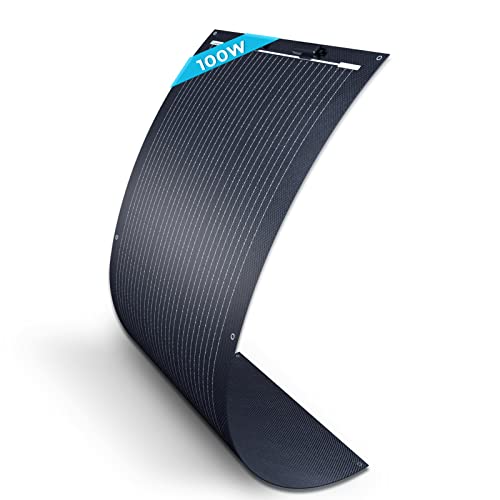
This ultra-light and bendable 100W panel is built for curved roof surfaces common on campers and vans. It can yield an average of around 500 Watt-hours per day under good sun, dependent on conditions. The flexible design, weight reduction to roughly one-third of rigid panels, and full coverage black appearance minimize visibility and wind resistance. With half-cut PERC cell technology, this panel offers high efficiency and improved output in varied sunlight, making it suitable for RVs, boats, and other off-grid setups where roof contours constrain rigid panels.
Eco-Worthy 200 Watts Solar Panel Kit

This 200W kit pairs a monocrystalline panel with a 30A PWM charge controller, targeting RVs, campers, and off-grid trailers. It claims daily outputs around 800Wh under four hours of strong sun, with compatibility for 12V and 24V systems. The panel uses corrosion-resistant aluminum framing and is designed to endure wind and snow loads, with IP65-rated junction protection. Its broad application scope covers boats, cabins, and portable power needs, offering a practical, ready-to-install solution for truck roof installations where simple integration is valued.
Renogy 200W ShadowFlux Anti-Shading N-Type Panel

Callout features include ShadowFlux anti-shading technology, designed to maintain high output when portions of the panel are shaded by trees or nearby structures. The 16BB busbar design with N-Type cells achieves 25% efficiency, reducing hot spots and micro-cracks for longer lifespan. Its compact form factor is about 7% smaller and 10% more compact than conventional PERC panels, making it especially suitable for narrow or irregular truck rooftops where space is limited but consistent performance is required.
Callsun N-Type 16BB Mini 100W Panel

The Callsun 100W mini panel uses N-Type cells and 16BB busbars to reach up to 25% efficiency, delivering higher power output in constrained roof spaces. It emphasizes reduced hot spots and improved durability with 16BB technology. The compact 31.1 x 22.7 x 1.1-inch footprint with pre-drilled mounting holes makes installation straightforward on vans, RVs, trucks, or other off-grid applications where space is at a premium. This panel is well-suited for maintaining essential electrical loads on smaller roof beds or trailers.
Buying Guide: Key Purchase Considerations
- Roof compatibility and space: Choose panels that fit the available roof area and are compatible with your mounting hardware. Curved or irregular surfaces may benefit from flexible or low-profile designs.
- Voltage and battery system: Most truck setups use 12V or 24V systems. Select panels that align with your battery bank and charge controller to maximize efficiency and minimize current losses.
- Monocrystalline vs polycrystalline: Monocrystalline panels typically offer higher efficiency and lighter weight, which is advantageous for roof installations and limited mounting space.
- Shading tolerance: Panels with anti-shading features, like ShadowFlux, perform more reliably in environments with partial shade from trees, rooftops, or nearby structures.
- Durability and weather sealing: Look for corrosion-resistant frames, IP-rated components, and robust mounting points to withstand road and weather conditions.
- Complete kits vs individual panels: Kits with controllers simplify wiring and setup for RVs and trucks. Individual panels provide customization but may require additional components.
- Weight considerations: Heavier rigid panels can affect payload and mounting hardware. Flexible panels reduce weight but may require careful mounting to prevent flex damage.
- Maintenance and warranties: Check for manufacturer warranties and service support, especially for off-grid or mobile use where reliability matters most.
Overall, choosing the best solar panel for a truck roof depends on roof geometry, power needs, and the desired balance between weight, efficiency, and ease of installation. The options listed here offer a range of form factors—from rigid high-efficiency panels to ultra-flexible sheets—each designed to deliver dependable daytime charging for on-the-road power needs.