RV adventures demand dependable power that can handle lights, appliances, climate control, and electronics without constant recharging. This guide reviews five top deep cycle batteries suitable for RV use, spanning AGM (maintenance-free) and LiFePO4 chemistries. Each pick balances capacity, safety, lifespan, and practical RV compatibility to help you choose a durable power source for weekend trips or full-time travel.
| Product | Brand | Chemistry | Capacity | Notes |
|---|---|---|---|---|
| Weize Deep Cycle AGM 12V 100Ah | WEIZE | AGM | 100Ah | Maintenance-free; low self-discharge; suitable for RV, solar, and off-grid uses |
| Renogy Deep Cycle AGM 12V 100Ah | Renogy | AGM | 100Ah | Trusted safety; versatile in series/parallel setups |
| GRNOE 2-Pack 12V 100Ah LiFePO4 | GRNOE | LiFePO4 | 100Ah per battery | Lightweight; built-in smart BMS; cold-weather protection |
| VATRER POWER 12V 100Ah LiFePO4 | VATRER POWER | LiFePO4 | 100Ah | High/low temp protection; expandable system with multiple packs |
| SUPER EMPOWER 12V 100Ah LiFePO4 | SUPER EMPOWER | LiFePO4 | 100Ah | Drop-in replacement potential; strong cycle life; built-in BMS |
Weize Deep Cycle AGM 100Ah Overview
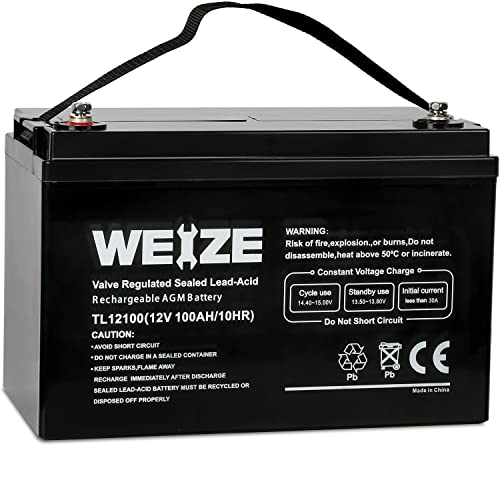
The Weize AGM battery provides a maintenance-free option for RV setups. Its AGM design minimizes acid leakage risk and reduces the need for regular watering or vent checks common with flooded lead-acid models. A compact 12.99 x 6.73 x 8.43 inch form factor makes it compatible with standard RV battery compartments. The battery features a low self-discharge rate, typically around 1–3% per month under proper storage conditions, helping preserve charge during longer trips or off-grid periods. It supports a high discharge current (up to 1100A for brief periods), which is useful for startup surges or powering demanding accessories. Temperature tolerance is broad, with charging and discharging ranges that cover typical RV operating environments. This makes it a practical, maintenance-free option for campers prioritizing reliability and simple maintenance.
Features to note include left-positive/right-negative terminal accessibility and a rugged sealed construction designed to resist leaks. While lead-acid chemistries are heavier than lithium alternatives, the Weize 100Ah AGM remains a widely compatible choice for many RV configurations, solar charging setups, and auxiliary power systems that don’t require the lighter weight of LiFePO4. For RV owners seeking a straightforward swap into existing 12V systems without changing wiring or charging protocols, this option offers a solid balance of affordability and dependable performance.
Renogy Deep Cycle AGM 100Ah: Safety and Versatility

Renogy’s 12V 100Ah AGM battery emphasizes safety and reliability with a sealed design and strong discharge performance. AGM chemistry provides maintenance-free operation with a reduced risk of electrolyte leaks. Renogy highlights compatibility with both series and parallel configurations, enabling scalable power banks for larger RV systems. The battery is designed to handle demanding loads typical of RV lifestyles, including lighting, climate control, and electronics, while delivering consistent voltage through deep discharge cycles. Renogy’s reputation in off-grid and RV circles adds confidence for buyers seeking a proven, widely supported option.
Key considerations include safe operation and long-term performance. The integrated safety profile minimizes maintenance challenges and troubleshooting compared with other chemistries. If you plan to expand your system later, the ability to connect multiple units in series or parallel can simplify expansion without reconfiguring existing wiring. For RVers who want a dependable, widely supported AGM option, this 100Ah model remains a strong candidate for mid-size to larger power needs.
GRNOE 2-Pack 12V 100Ah LiFePO4: Lightweight and Efficient

This option pairs two 12V LiFePO4 batteries, offering a lighter alternative to traditional lead-acid packs while delivering robust cycle life. LiFePO4 chemistry is known for a longer lifespan, often exceeding 10 years with thousands of charge-discharge cycles, and substantially lower self-discharge. The included smart BMS provides protection against overcharge, over-discharge, overcurrent, short circuits, and temperature extremes, helping to preserve capacity in RV environments with variable charging conditions. A low-temperature cut-off helps prevent charging when temperatures fall below safe thresholds, which is especially valuable in cold climates where RV camping occurs.
Consider weight and space savings, since LiFePO4 packs are typically much lighter than lead-acid equivalents for the same capacity. This kit supports expansion and adaptability for RV floors or battery compartments with limited space. However, users should ensure their charging setup matches the BMS requirements, including recommended charge voltages and currents. For RVers seeking a lighter, long-lasting alternative to AGM batteries with advanced protection, the GRNOE LiFePO4 duo offers compelling value.
VATRER POWER 12V 100Ah LiFePO4: Temperature Guardrails

The VATRER POWER LiFePO4 100Ah battery emphasizes temperature protection and a robust 100A BMS. It supports charging and discharging across a wide temperature spectrum, with cutoffs to prevent damage in extreme heat or cold. The 100A BMS provides essential safety against overcharging, over-discharging, and short circuits, while auto-balancing helps maintain consistent cell performance across multiple modules. The design supports expandable capacity, enabling RV owners to scale their power system by adding more packs as needed.
This battery is suitable for RVs that demand reliable electrical performance in diverse environments, from hot desert campsites to chilly mountain travels. Prospective buyers should verify compatibility with their existing charging sources, especially if they plan to run high-current appliances or pair with solar charge controllers that have specific voltage or current requirements. For long-term power reliability and flexible expansion, VATRER POWER’s LiFePO4 option offers solid advantages in RV power management.
SUPER EMPOWER 12V 100Ah LiFePO4: Long Lifespan and Safety

This LiFePO4 option from SUPER EMPOWER emphasizes a long cycle life and robust safety features. With a Grade A+ cell composition and a built-in BMS, the battery is designed for RV, marine, trolling motor, and solar applications. The stated cycle life figures indicate thousands of usable cycles, delivering consistent performance well beyond traditional lead-acid batteries. The battery’s compact drop-in form factor and 100Ah capacity make it a practical choice for RV owners who want a lightweight, scalable, and efficient power source. The BMS protects against common failure modes, reducing the risk of unexpected downtime during trips.
Buyers should assess charging strategies—LiFePO4 cells typically require a charging profile around 14.6V, depending on the BMS and controller used. While these batteries offer substantial efficiency and longevity, proper charging equipment and wiring are essential to maximize life and performance in RV setups. For travelers prioritizing duration between charges and a safer, longer-lasting alternative to lead-acid, SUPER EMPOWER provides a compelling option.
Buying Guide: Key Considerations For RV Battery Purchases
- Chemistry and lifespan: AGM offers maintenance-free operation and solid performance with moderate weight, while LiFePO4 delivers longer life, lighter weight, deeper discharges, and better cycle counts. Decide based on how often you camp, the size of your electrical load, and your willingness to manage charging profiles.
- Capacity and expansion: Calculate your total daily energy consumption and desired autonomy. If you plan to expand, ensure the battery system supports series/parallel configurations and has a compatible BMS or management system for safe scaling.
- Weight and space: LiFePO4 packs are typically lighter and more compact for the same usable capacity, an important factor for RV storage and weight limits.
- Charging compatibility: Verify compatibility with your RV’s charger, solar controller, and any in-vehicle alternators. Some LiFePO4 packs require specific charge voltages (e.g., around 14.6V) and current limits to achieve full performance and longevity.
- Temperature resilience: Look for batteries with temperature protection and wide operating ranges, especially if you travel through extreme climates. Temperature cutoffs help guard against charging into unsafe conditions.
- Maintenance and safety: AGM batteries are generally maintenance-free but heavier; LiFePO4 batteries offer enhanced safety features, lower self-discharge, and longer life but can have higher upfront costs. Consider total ownership cost, not just purchase price.
- Compatibility with solar: If you use solar, ensure the battery type and BMS coordinate with your solar charge controller, battery monitor, and wiring. LiFePO4 often pairs well with solid BMS protection for off-grid power.
- Warranty and support: Review manufacturer warranties and availability of local support. A strong warranty can offset higher upfront cost and provide confidence in longer-term RV life.